Closed-Loop Cognitive Targeting: When Influence Systems Learn From Their Targets

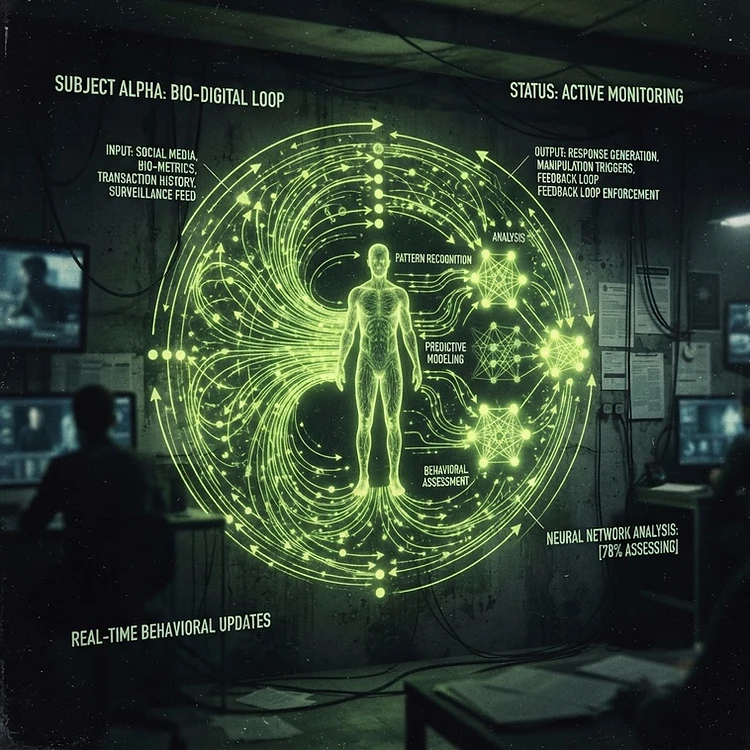
Adaptive influence systems could analyze responses, update behavioral models, and continuously modify their strategy based on changing reactions. This report examines the five components of the closed loop, the four kinds of learning the loop performs, the cycle that makes the operation a learning system, and why the closed loop makes the operation faster, more adaptive, more individual, and more persistent than any open-loop campaign.
The Open Loop and the Closed Loop
The influence operation, for most of its history, was an open-loop system. The operator would design a message, deliver it to an audience, and observe the audience's response. The observation would, in the best operations, inform the next message, but the next message was designed by the operator, not by the system, and the design was a human act that took time, judgment, and resources. The loop, in this sense, was open: the response fed back to the operator, but the operator's interpretation of the response, and the operator's decision about the next action, were the links in the loop that the system did not close. The loop was, in practice, a loop with a human in it, and the human was the loop's latency, its bottleneck, and its limit.
The open-loop operation was, in its design, a system that learned slowly. The operator who observed a response, interpreted it, and designed the next message was an operator who learned at the pace of human analysis — the hours of the review, the days of the strategy session, the cycle of the campaign. The learning was, in this sense, real but slow, and the slowness was the constraint that kept the operation's adaptivity within the bounds of what a human team could manage. The operation that would adapt in minutes, or in seconds, was an operation that the open-loop design could not sustain, because the open-loop design required the human to be in the loop, and the human could not be in the loop at the speed the adaptation required.
The closed-loop cognitive targeting system removes the human from the loop. A closed-loop system is one that, having delivered a message, observes the response, updates its model of the target, and modifies its next action — all without human intervention. The system is, in this sense, a learning system: it learns from the target's response, and the learning is the basis of the next action. The closed loop is the loop that the open-loop operation aspired to but could not achieve, because the closed loop is the loop that the system closes, and the system closes it at a speed, a scale, and a frequency that the human in the loop cannot match. The closed-loop system is, in 2027, the system that most defines the frontier of the influence operation, and the system that most changes the threat.
The Components of the Closed Loop
The closed-loop cognitive targeting system is built from several components, and the integration of the components is what makes the loop closed.
The model. The first component is the model — the representation of the target that the system uses to predict the target's response. The model is, in 2027, a behavioral model that represents the target's psychology, their values, their anxieties, their susceptibilities, their network, and their history of responses. The model is, in its structure, a predictive instrument: given a candidate message, the model predicts the target's response, and the prediction is the basis of the system's decision. The model is, in this sense, the component that most defines the closed-loop system, because the model is the component that the loop updates, and the updating of the model is the learning that the loop performs.
The delivery. The second component is the delivery — the mechanism by which the system delivers the message to the target. The delivery is, in 2027, conducted through the same channels as any influence operation — social media, messaging, email, voice — and the delivery is, in the closed-loop system, integrated with the model: the system selects the channel, the timing, and the framing that the model predicts will be most effective for the target. The delivery is, in this sense, the component that most connects the model to the target, and the connection is the precondition for the response.
The observation. The third component is the observation — the mechanism by which the system observes the target's response. The observation is, in 2027, conducted through the same channels as the delivery, and the observation is, in the closed-loop system, comprehensive: the system observes the target's engagement, their sentiment, their behavior, their network activity, and, where available, their physiological signals. The observation is, in this sense, the component that most connects the target back to the model, and the connection is the precondition for the learning.
The update. The fourth component is the update — the mechanism by which the system updates its model based on the observation. The update is, in 2027, performed by the system's learning algorithm, and the update is, in the closed-loop system, continuous: each observation is fed back into the model, and the model is revised to reflect the new information. The update is, in this sense, the component that most defines the learning, because the update is the act by which the system's representation of the target becomes more accurate, and the more accurate representation is the basis of the more effective next action.
The adaptation. The fifth component is the adaptation — the mechanism by which the system modifies its next action based on the updated model. The adaptation is, in 2027, performed by the system's planning and generation layer, and the adaptation is, in the closed-loop system, immediate: the updated model is used to predict the response to the candidate next actions, and the action with the best predicted response is selected. The adaptation is, in this sense, the component that most defines the operation's behavior, because the adaptation is the act by which the system's strategy changes in response to the target's changing response.
How the Loop Learns
The closed loop is, at its core, a learning process, and the learning is the property that most distinguishes the closed-loop system from the open-loop operation. The learning is, in 2027, a process of several kinds.
The first kind of learning is the learning of the target's psychology. The system that delivers a message and observes the response learns, from the response, something about the target's psychology — what they attend to, what they engage with, what they ignore, what they resist, what they share. The learning is, in this sense, the learning of the target's behavioral signature, and the signature is the basis of the model's prediction. The system that delivers a thousand messages and observes a thousand responses learns a thousand signatures, and the thousand signatures are the basis of a model that is, in its fidelity, beyond the reach of the human analyst who observes a handful.
The second kind of learning is the learning of the target's state. The target's state — their stress, their fatigue, their attention, their arousal — is, in 2027, partially observable from the target's behavioral and physiological signals, and the system that observes the signals learns, from the signals, the target's current state. The learning is, in this sense, the learning of the target's window of receptivity, and the window is the basis of the system's timing. The system that can read the window can deliver the message in the window, and the message delivered in the window is more effective than the message delivered outside it.
The third kind of learning is the learning of the target's network. The target's network — their connections, their influencers, their communities — is, in 2027, partially observable from the target's public activity, and the system that observes the activity learns, from the activity, the target's network. The learning is, in this sense, the learning of the target's social context, and the context is the basis of the system's network exploitation. The system that can read the network can identify the nodes whose influence on the target is greatest, and the engagement of the nodes is more effective than the engagement of the target alone.
The fourth kind of learning is the learning of the operation's own effectiveness. The system that delivers a message and observes the response learns, from the response, something about the message — what worked, what did not, what could be improved. The learning is, in this sense, the learning of the operation's craft, and the craft is the basis of the system's content production. The system that can learn from its own effectiveness is a system that improves its content with every engagement, and the improvement is the property that most makes the closed-loop system a learning system rather than a repeating one.
The Loop in Action
The closed-loop system, in operation, runs a cycle that the open-loop operation could not sustain. The cycle is, in 2027, a cycle of seconds, and the cycle is the operation's engine.
The cycle begins with the model. The system, holding a model of the target, generates a set of candidate messages — each crafted, by the generative layer, to resonate with the target's modeled psychology. The model predicts the target's response to each candidate, and the system selects the candidate with the best predicted response. The system delivers the selected message through the channel, at the time, and in the frame that the model predicts will be most effective. The target receives the message, and the target responds — or does not. The system observes the response, across the channels it monitors, and the observation is fed back into the model. The model is updated, the update is used to generate the next set of candidates, and the cycle repeats.
The cycle is, in this sense, a cycle of continuous engagement, continuous observation, continuous learning, and continuous adaptation. The cycle is, in 2027, a cycle that runs at a speed the human-paced operation cannot match, and a cycle that runs at a scale the human-paced operation cannot reach. The cycle is, in this sense, the operation's defining property, and the property that most changes the threat: the operation that runs the cycle is an operation that is always learning, always adapting, and always engaging, and the operation that is always learning, adapting, and engaging is an operation that is different in kind from the operation that runs in cycles of hours and days.
The cycle also runs across many targets simultaneously. The system that holds models of a thousand targets, and that runs the cycle for each, is a system that is learning about a thousand targets at once, and the learning about each target informs the learning about all. The target whose response to a frame is positive is a target whose response is a signal about the frame, and the signal is a signal about the frame's effectiveness for other targets who share the target's modeled psychology. The learning is, in this sense, a learning that transfers, and the transfer is the property that most makes the closed-loop system a system that learns about populations as well as individuals.
What the Loop Changes
The closed loop changes the influence operation in several ways, and each change is a change in the threat.
The operation becomes a learning system. The first change is that the operation becomes a learning system — a system that improves its effectiveness with every engagement. The open-loop operation that learned at the pace of human analysis was an operation that learned slowly, and the slowness was the constraint that kept the operation's effectiveness bounded. The closed-loop system that learns at the pace of the model's update is a system that learns fast, and the fastness is the property that makes the system's effectiveness unbounded by the human's analysis. The operation that is a learning system is, in this sense, an operation that gets better the more it runs, and the getting-better is the property that most distinguishes the closed-loop system from the open-loop operation.
The operation becomes adaptive. The second change is that the operation becomes adaptive — a system that changes its strategy in response to the target's changing response. The open-loop operation that adapted at the pace of the strategist's decision was an operation that adapted slowly, and the slowness was the constraint that kept the operation's adaptivity within the bounds of what the strategist could manage. The closed-loop system that adapts at the pace of the model's update is a system that adapts fast, and the fastness is the property that makes the system's adaptivity unbounded by the strategist's decision. The operation that is adaptive is, in this sense, an operation that can respond to the target's counter, and the response is the property that most makes the operation resilient.
The operation becomes individual. The third change is that the operation becomes individual — a system that tailors its message, its timing, and its channel to the individual target. The open-loop operation that tailored at the pace of the copywriter's craft was an operation that tailored coarsely, and the coarseness was the constraint that kept the operation's tailoring within the bounds of what the copywriter could produce. The closed-loop system that tailors at the pace of the generative layer is a system that tailors finely, and the fineness is the property that makes the system's tailoring unbounded by the copywriter's craft. The operation that is individual is, in this sense, an operation that engages the target as an individual, and the engagement is the property that most makes the operation effective.
The operation becomes persistent. The fourth change is that the operation becomes persistent — a system that engages the target continuously, over time, and that learns the target's evolution over time. The open-loop operation that engaged in campaigns was an operation that engaged intermittently, and the intermittence was the constraint that kept the operation's engagement within the bounds of the campaign's cycle. The closed-loop system that engages continuously is a system that engages persistently, and the persistence is the property that makes the system's engagement unbounded by the campaign's cycle. The operation that is persistent is, in this sense, an operation that is always present, and the presence is the property that most makes the operation a feature of the target's information environment rather than an event in it.
The Defensive Problem
The defense against the closed-loop cognitive targeting system is, in 2027, a problem that is defined by the system's learning.
The first problem is that the system's learning makes the system hard to predict. The defense that would counter the operation's message is a defense that is, by the time it has crafted the counter, facing a system that has already moved on — that has observed the counter, updated its model, and adapted its message. The defense that is human-paced is, in this sense, a defense that is inside the system's loop, and the defense that is inside the loop is a defense that is always reacting to the system's last action rather than anticipating its next. The defense's problem is, in this sense, a problem of pace, and the pace is a pace the defense cannot match without automating its own response.
The second problem is that the system's learning makes the system hard to detect. The system that tailors its message to the individual, and that adapts its message to the individual's response, is a system that produces messages that are, by construction, indistinguishable from the individual's organic information environment. The message that is crafted for the individual, and that is updated based on the individual's response, is a message that is, to the observer, a message that looks like the individual's other content. The defense's problem is, in this sense, a problem of detection, and the detection is a detection that the defense cannot perform without a model of the system's behavior.
The third problem is that the system's learning makes the system hard to attribute. The system that learns from its targets is a system that is, in its behavior, a function of its targets, and the behavior is, in this sense, not a signature of the operator but a signature of the target. The attribution that would identify the operator from the operation's behavior is an attribution that is, in the closed-loop system, confounded by the system's adaptation, because the adaptation makes the operation's behavior a reflection of the target's response rather than the operator's intent. The defense's problem is, in this sense, a problem of attribution, and the attribution is an attribution that the defense cannot perform without a model of the system's learning.
The defense that is emerging is, in 2027, a defense that is beginning to adopt the system's methods — the automated detection, the automated counter, the automated monitoring — and the adoption is, in its current state, a development that is necessary but insufficient, because the defense's adoption is, in 2027, behind the offense's adoption, and the offense's adoption is, in 2027, accelerating. The defense that will emerge is not yet clear, but the defense that will not emerge is the defense that relies on the human's pace, the human's detection, and the human's attribution — the defense that assumes the operation is open-loop. The operation, in 2027, is closed-loop, and the defense that assumes it is open-loop is a defense that is already behind.
Conclusion
The closed-loop cognitive targeting system is the influence operation that learns from its targets, and the learning is the property that most changes the threat. The system that observes the response, updates the model, and adapts the action is a system that is a learning system, and the learning is the property that makes the system's effectiveness unbounded by the human's analysis, the human's decision, and the human's craft. The system that is a learning system is a system that gets better the more it runs, and the getting-better is the property that most distinguishes the closed-loop system from the open-loop operation.
The defense is, in 2027, facing a system that is faster, more adaptive, more individual, and more persistent than any open-loop operation has been, and the defense that is open-loop is a defense that is inside the system's loop. The defense that is emerging is a defense that is beginning to adopt the system's methods, and the adoption is necessary but insufficient, because the adoption is behind the offense's adoption, and the offense's adoption is accelerating. The defense that will emerge is not yet clear, but the defense that will not emerge is the defense that relies on the human's pace, detection, and attribution.
The loop is closing. The systems are learning, and they are learning from the targets they engage. And the question is whether the society that is the target of the system can, in time, build a defense that is as learning, as adaptive, and as persistent as the offense — or whether the closed loop will, in 2027, be a capability that the defense cannot match, and a capability that the target, in the act of responding, cannot help but teach.
This dossier is part of the CyberArmory 2027 educational catalog. No live weapons are deployed. Every scenario is a controlled educational simulation designed to build pattern recognition and improve incident response readiness.
This report was compiled by the CyberArmory 2027 Research Collective as part of an educational dossier on speculative future cyber warfare technologies. No live weapons are deployed. Every scenario is a controlled educational simulation designed to build pattern recognition and improve incident response readiness.