From Propaganda to Personalized Influence: The New Cognitive Battlefield
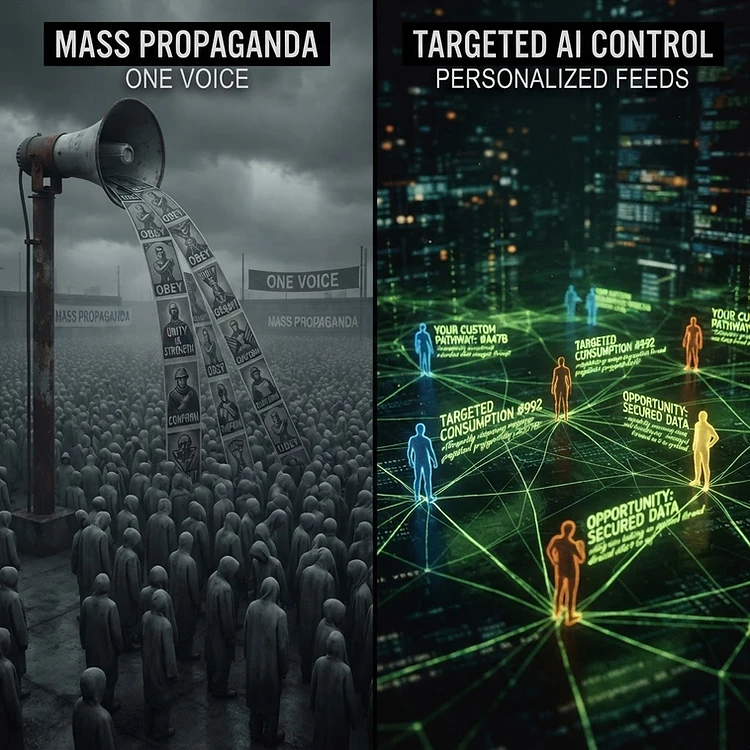
Modern influence operations are shifting away from broad propaganda campaigns toward individualized and micro-targeted psychological pressure. This report examines the collapse of the broadcast compromise, the mechanics of micro-targeting, what the personalized campaign can do that the broad campaign could not, and why the defense of transparency is giving way to a defense of infrastructure on the new cognitive battlefield.
The Era of the Megaphone
Propaganda, for most of its history, was a weapon of scale. Its objective was to move a population, and its method was to move the population with the same message. The propagandist crafted a slogan, an image, a frame, and the infrastructure of the age — the printing press, the radio, the television, the billboard — delivered that message to as many people as the infrastructure could reach. The art was the art of the message: a phrase that would stick, an image that would endure, a frame that would come to define the issue for the audience that received it. The measure of a campaign was the size of the audience it reached and the consistency of the message it delivered.
The broad campaign had a logic, and the logic was the logic of the broadcast. A single message, pushed at a mass audience, would move some fraction of that audience, and the fraction would be larger than any one-to-one effort could achieve. The campaign did not need to know who, specifically, it had moved; it needed to know, in the aggregate, that the population had shifted. The tools of measurement — the poll, the election, the market survey — were aggregate tools, and they matched the aggregate nature of the campaign. The propagandist was, in this era, a broadcaster, and the broadcaster's skill was the skill of reaching many with one.
The broad campaign also had a limit, and the limit was the limit of the broadcast. A single message could not be optimal for every recipient, because the recipients were not the same. The propagandist compromised: the message was crafted to move the median member of the target audience, and the members who were not the median were reached less effectively, or not at all. The campaign was, in this sense, a blunt instrument — effective against the center of the distribution, ineffective against the tails, and unable to reach the individuals whose psychology placed them outside the message's design. The broad campaign left on the table the individuals it could not reach, and it accepted the loss as the cost of the method.
The Shift to the Individual
The cognitive battlefield of 2027 is defined by the collapse of this compromise. The influence operation no longer needs to craft a single message for the median; it can craft a distinct message for each individual, and it can deliver that message through a channel, at a time, and in a form that is, for that individual, optimal. The shift is not a refinement of the broad campaign; it is a change in the unit of the operation. The unit is no longer the population, or the segment, or the demographic. The unit is the person.
The shift is enabled by the availability of individual-level data, the computational capacity to model each individual from that data, and the generative capacity to produce a tailored message for each model. The data is the raw material: the traces of behavior, preference, association, and expression that every connected person generates, and that are, in 2027, collected, aggregated, and made available to the operator through a combination of legitimate platforms, data brokers, and extralegal collection. The model is the engine: a representation of the individual's psychology — their values, their anxieties, their identifications, their susceptibilities — constructed from the data by systems that can build and maintain such models for millions of individuals simultaneously. The message is the output: a narrative, a frame, a piece of content, generated for the individual and optimized to move their model in the desired direction.
The result is an influence operation that does not broadcast but converses. Each individual in the target population is engaged in a distinct interaction, sustained over time, and adapted as the individual responds. The operation does not push a message at a crowd; it holds a conversation with each member of the crowd, and the conversation is, by design, more effective than the broadcast, because it is tailored to the person it is having the conversation with.
Micro-Targeting and Psychological Pressure
The move to the individual is, in the first instance, a move of targeting — the replacement of the demographic segment with the psychological profile. But the deeper change is in the nature of the pressure the operation can apply, and this is the change that most defines the new cognitive battlefield.
The broad campaign applied pressure through repetition and volume. The message was heard many times, by many people, and the repetition was the mechanism by which the message became the frame. The pressure was, in this sense, a pressure of exposure — the audience was exposed to the message until the message became the way they thought about the issue. The pressure was blunt, and it was applied to the aggregate.
The personalized campaign applies pressure through precision and relevance. The message is not repeated; it is evolved. Each interaction with the individual produces a response, and the response is fed back into the model, and the next message is adjusted to be more effective. The pressure is not a pressure of exposure but a pressure of resonance — the message resonates with the individual's specific psychology, and the resonance is the mechanism by which the message moves the individual. The pressure is sharp, and it is applied to the person.
The sharpness of the pressure changes what the operation can do. The broad campaign could shift an aggregate — move a population's average attitude by some amount — but it could not reliably move a specific individual, because the individual's psychology was not, in the broad campaign, the unit of design. The personalized campaign can move a specific individual, because the individual is the unit of design, and the message is crafted to move that individual. The operation that could, in the broad era, shift a population can, in the personalized era, shift a person — and the person may be a voter whose shift decides an election, an official whose shift decides a policy, a trader whose shift moves a market, or an engineer whose shift opens a system.
The sharpness also changes the visibility of the operation. The broad campaign was, by nature, visible — a message pushed at a population is a public act, and the public act is observable. The personalized campaign is, by nature, invisible — a message tailored to an individual and delivered through a channel the individual uses privately is a private act, and the private act is not observable by the public, by the press, or, in many cases, by the individual's own social network. The operation that was, in the broad era, a matter of public record becomes, in the personalized era, a matter of private interaction, and the privacy is the operation's cover.
The Mechanics of Micro-Targeting
The micro-targeted campaign is built on a set of mechanics that, together, enable the shift from the population to the person, and each of these mechanics is more developed in 2027 than at any prior point.
Data assembly. The first mechanic is the assembly of the individual's data profile. The profile is built from the individual's own behavior — their posts, their clicks, their purchases, their locations, their searches — and from the behavior of those around them, whose data, through network inference, reveals properties of the individual that the individual's own data does not. The assembly is, in 2027, comprehensive: the average connected person generates enough behavioral data to support a detailed psychological model, and the data is available, through a combination of platforms and brokers, to any operator with the resources to acquire it. The data is not, in most cases, collected by the operator; it is purchased, or accessed, or inferred, and the assembly is a matter of integration, not collection.
Psychological modeling. The second mechanic is the construction of the psychological model from the data. The model is not a demographic profile — it does not represent the individual's age, gender, and location, though it may include these. It represents the individual's psychology: their values, their anxieties, their identifications, their susceptibilities to specific narratives, their likely reactions to specific framings, and the network of beliefs that determines which messages will resonate. The model is, in 2027, constructed by systems that have been trained on the relationship between behavioral data and psychological traits, and that can infer the traits from the data with a fidelity that human analysts cannot match. The model is also dynamic: it updates as new data arrives, and the individual whose model was accurate yesterday is the individual whose model is updated today.
Message generation. The third mechanic is the generation of the message for the individual's model. The message is not selected from a library; it is produced, by a generative system, for the specific individual and the specific objective. The message may be a social media post, a direct message, a comment, an image, a video, or a full conversation, and it is crafted to resonate with the individual's model and to move the model in the desired direction. The generation can produce, for the same objective, radically different messages for different individuals, and each message is, for its recipient, the most effective available.
Delivery and feedback. The fourth mechanic is the delivery of the message through the channel the individual is most receptive to, at the time they are most receptive, and the observation of the individual's response. The response — engagement, sentiment, behavior, downstream action — is fed back into the model, and the next message is adjusted. The loop is closed, and the campaign that results is a living system that adapts to its audience, not a fixed plan that is executed and evaluated.
What the Personalized Campaign Can Do That the Broad Campaign Could Not
The shift from the broad to the personalized campaign is not a shift of degree but of capability. The personalized campaign can do things the broad campaign could not, and these new capabilities are what define the new cognitive battlefield.
It can reach the unreachable. The broad campaign could not reach the individuals whose psychology placed them outside the message's design — the tails of the distribution, the non-median members of the audience. The personalized campaign can reach these individuals, because it does not design for the median; it designs for each. The individuals who were, in the broad era, immune to the campaign because no single message would move them become, in the personalized era, reachable, because the message that will move them is crafted for them.
It can sustain the pressure. The broad campaign's pressure was a pulse — a message pushed, and then another, and then another, with the effect decaying between pushes. The personalized campaign's pressure is a current — a continuous interaction that does not decay, because it is sustained by the closed loop. The individual who is engaged in the conversation is engaged for as long as the conversation continues, and the conversation continues for as long as it is useful. The sustained pressure is more effective than the pulsed pressure, because it does not give the individual the interval in which to recover, to question, or to be reached by a counter-message.
It can hide. The broad campaign was a public act, and the public act could be observed, reported, and countered by the institutions — the press, the fact-checker, the counter-propagandist — that monitor the public sphere. The personalized campaign is a private act, and the private act is not observed by the institutions that monitor the public sphere. The campaign that is invisible to the press is a campaign that is not reported, and the campaign that is not reported is a campaign that the public does not know is happening. The invisibility is not a side effect; it is a capability, and it is the capability that most changes the defensive problem.
It can target the decisive individual. The broad campaign targeted the population, because the population was the unit of effect. The personalized campaign can target the individual, because the individual is the unit of effect. The operation that, in the broad era, could shift a population can, in the personalized era, shift a person — and the person can be the one whose shift matters. The voter whose vote decides a margin, the official whose decision sets a policy, the engineer whose access opens a system, the leader whose statement moves a market — the personalized campaign can find these individuals, model them, and engage them, and the engagement can be the difference.
The Defensive Problem on the New Battlefield
The defense against the personalized influence operation is, in 2027, a different problem than the defense against the broad campaign, and the difference is a consequence of the shift from the public to the private and from the aggregate to the individual.
The defense against the broad campaign was a defense of the public sphere. The press reported the campaign, the fact-checker evaluated its claims, the counter-propagandist offered an alternative frame, and the public, informed of the campaign, could weigh it. The defense was, in this sense, a defense of transparency — the campaign was made visible, and the visible campaign was less effective, because the audience that knew it was a campaign could discount it. The defense worked because the campaign was a public act, and the public act could be made visible to the public.
The defense against the personalized campaign cannot rely on transparency, because the campaign is not a public act. The message is delivered to the individual, in a private channel, and the individual is, in many cases, the only witness to the message. The press cannot report a message it does not see; the fact-checker cannot evaluate a claim it does not receive; the counter-propagandist cannot rebut a frame that is not in the public sphere. The defense of transparency, which was the defense of the broad-campaign era, is a defense without a target in the personalized era, and the institutions that were the defense's instruments are, in this era, instruments without a field of operation.
The defense that is emerging is a defense of a different kind, and it is built on a different insight. The insight is that the personalized campaign, to be effective, must observe the individual's behavior, and the observation is a point of leverage. The defense that monitors the observation — that detects the data collection, the model construction, the message generation, the closed loop — can, in principle, detect the campaign, even if it cannot see the campaign's content. The defense is, in this sense, a defense of the infrastructure rather than the message, and it is a defense that requires a different set of capabilities than the press and the fact-checker provided.
The defense is also, in 2027, a defense that is in tension with the values it protects. The personalized campaign operates through the same infrastructure of data collection and behavioral observation that the legitimate economy operates through, and the defense that would monitor the infrastructure is a defense that would monitor the economy. The surveillance that would detect the influence operation is the surveillance that would observe the population, and the defense that protects the population from personalized influence is, in its method, a defense that subjects the population to surveillance. The tension is not a bug; it is the structural problem of the new battlefield, and it is the problem that the defensive community is, in 2027, still working to navigate.
Conclusion
The shift from propaganda to personalized influence is the shift from the megaphone to the conversation. The broad campaign, which moved a population with a single message, is being replaced by the personalized campaign, which moves each individual with a tailored message, sustained over time, and adapted to the individual's response. The shift changes the unit of the operation from the population to the person, the nature of the pressure from exposure to resonance, the visibility of the campaign from public to private, and the target of the operation from the aggregate to the decisive individual.
The new cognitive battlefield is defined by these changes, and the changes are, together, a change in what influence operations can do. The operation that could shift a population can now shift a person, and the person can be the one whose shift matters. The operation that was a public act is now a private interaction, and the privacy is the operation's cover. The operation that was countered by the transparency of the public sphere is now, in the personalized era, a operation that the public sphere cannot see.
The defense is, in 2027, still being built, and it is being built on a different foundation than the defense of the broad-campaign era. The defense of transparency is giving way to the defense of infrastructure, and the defense of the press is giving way to the defense of the system. The transition is not complete, and the society that navigates it successfully is the society that protects its members from personalized influence without subjecting them to the surveillance that would detect it. The balance is the challenge of the new cognitive battlefield, and the outcome of the balance is, in 2027, not yet decided.
The megaphone is silent. The conversation has begun. And the question is who, in the new battlefield, is having the conversation with whom.
This dossier is part of the CyberArmory 2027 educational catalog. No live weapons are deployed. Every scenario is a controlled educational simulation designed to build pattern recognition and improve incident response readiness.
This report was compiled by the CyberArmory 2027 Research Collective as part of an educational dossier on speculative future cyber warfare technologies. No live weapons are deployed. Every scenario is a controlled educational simulation designed to build pattern recognition and improve incident response readiness.