Silent War in Orbit: Soft Disruptions in Space, Hard Effects on Earth
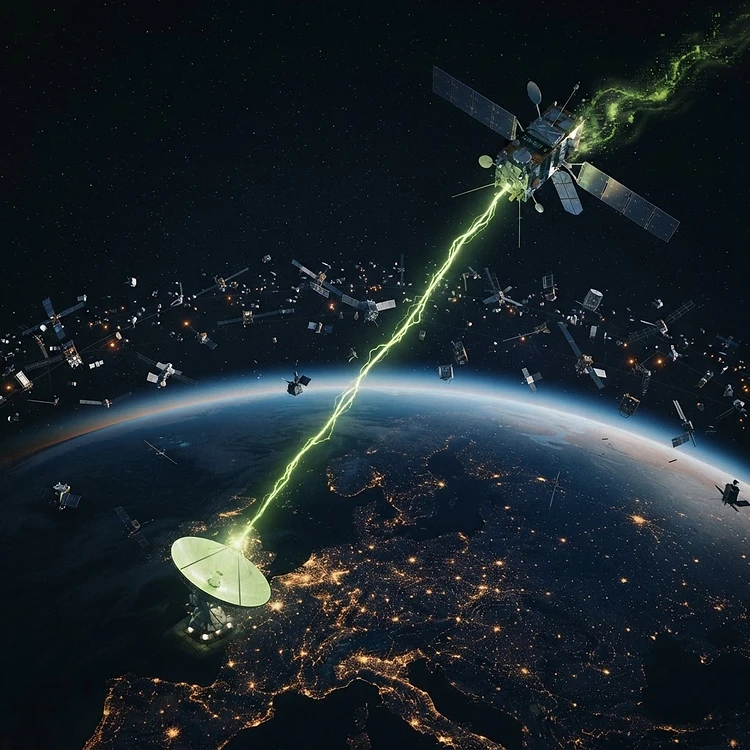
Cyber operations against satellites, ground stations, and space-dependent timing and communications are designed to be invisible in space so their effects can be deniable on Earth. This report examines why a soft disruption in orbit cascades into harder effects on the ground than a classic terrestrial outage — through timing corruption, selective communications degradation, and Earth-observation data manipulation — and why the space layer is the new strategic high ground of cyber conflict.
The War No One Sees
A war in orbit is, by design, a war no one sees. There are no explosions in the vacuum. No columns of smoke. No flash visible from the ground. A satellite that has been compromised does not tumble or break apart; it continues its pass, on its nominal orbit, transmitting on its nominal frequency, its telemetry within nominal parameters. The ground station that has been infiltrated does not go dark; it continues to track, to command, to downlink. To an observer on Earth — and to most of the monitoring infrastructure built to watch the space layer — nothing has happened. The constellation is intact. The links are up. The service is nominal.
This is the first fact of the silent war in orbit: its operations are designed to be invisible. The attacker's objective is not to destroy a satellite or a ground station. Destruction is loud, attributable, and within the reach of the existing norms and treaties that govern kinetic antisatellite action. The attacker's objective is to use the satellite, the ground station, or the link between them as a vector — to corrupt what the space layer does for the ground, without leaving evidence that the space layer has been touched at all. The attack is soft in space precisely so that its effects can be hard on Earth, and hard in a way that is difficult to trace back to its cause.
The second fact follows from the first. The space layer has become, in 2027, a load-bearing layer of the terrestrial economy and the terrestrial state. Communications, timing, navigation, weather, financial settlement, logistics, military command and control — each depends, in ways that are often invisible to the end user, on satellites and ground stations. A soft disruption in space propagates downward, through the services that depend on the space layer, into the systems on Earth that depend on those services. The disruption arrives on the ground as a degraded service, a mistimed transaction, a misrouted shipment, a lost communication — effects that look terrestrial and are traced to terrestrial causes, because the terrestrial system is where the symptom appears. The space layer, where the cause lies, is not where the investigation looks.
This is why a soft disruption in space can have harder effects on Earth than a classic terrestrial outage. A terrestrial outage is visible, local, and contained to the system that failed. A space-layer disruption is invisible, distributed, and cascades through every system that depends on the space layer. The terrestrial outage is a broken pipe. The space-layer disruption is a poisoned aquifer.
What the Space Layer Does for the Ground
To understand the leverage of a space-layer attack, it is necessary to understand what the space layer does for the ground. The dependence is deeper than is commonly assumed, because the space layer's services are often invisible to the end user — embedded in systems that present themselves as terrestrial.
Timing. The Global Navigation Satellite Systems — GPS, Galileo, BeiDou, GLONASS — are, for most of their users, not navigation systems at all. They are timing systems. The precise time signal broadcast by the constellation is the reference clock for the financial markets' trade timestamps, the phase reference for power-grid synchronization, the sequence number for cellular network handoffs, and the timestamp for log correlation across distributed systems. A degradation of the timing signal — not its loss, which would be noticed, but its subtle corruption, which would not — propagates into every system that uses it. Trades settle at wrong timestamps and become unmatchable. Grid phase drifts and protective relays trip. Cellular handoffs fail and calls drop. Log sequences break and incident response loses its timeline. None of these failures is attributed to the space layer, because none of them appears as a timing failure — they appear as a market glitch, a grid fault, a network outage, a logging bug.
Communications. Satellite communications carry traffic that terrestrial networks cannot — to remote locations, to maritime and aviation users, to military units beyond terrestrial reach, and, increasingly, as a backhaul and resilience layer for terrestrial networks that need redundant paths. A compromise of satellite communications does not take the traffic down; it degrades it, selectively, in ways that look like congestion or weather. The traffic that is most sensitive — the traffic whose loss or delay is most consequential — can be targeted for degradation while the overall service appears nominal. The attacker who can select which traffic to degrade can impose asymmetric costs: the commercial traffic flows, the military traffic stutters.
Earth observation. The imagery and radar data produced by Earth-observation satellites feed logistics planning, agricultural forecasting, disaster response, and military intelligence. A compromise that subtly alters the data — shifts a coordinate, changes a timestamp, degrades a resolution — produces decisions on the ground that are wrong in ways that reflect the corruption. A logistics plan built on corrupted imagery routes assets to the wrong place. A military assessment based on altered radar misjudges the threat. The corruption is in the data, but the consequence is in the decision, and the decision is made on the ground, far from the satellite that supplied the data.
Command and control. For military users, the space layer is the backbone of beyond-line-of-sight command and control. Orders, situational awareness, and intelligence flow through satellites to units that have no terrestrial path. A soft disruption of this layer — one that does not break the link but that introduces latency, reorders messages, or selectively drops packets — degrades the coherence of the force without the visible loss of communication. Units receive orders, but late, or out of sequence, or with missing context. The command authority believes its orders were sent; the units believe they received what was sent; the gap between the two is the attacker's contribution, and it is invisible to both ends.
The Vectors of Silent War
The attack surface of the space layer has three main components: the satellites themselves, the ground stations that command and downlink them, and the links between them. Each has its own vectors, and each is the subject of a distinct offensive discipline.
Satellite compromise. The satellite is a computing platform in a hostile environment. It runs software, it has processors and memory, it has communication interfaces, and it has a command-and-control relationship with its ground station. Every one of these is an attack surface. Firmware updates, if they can be intercepted or forged, can install persistent compromise on the satellite. Telemetry, if it can be altered, can mislead the operator about the satellite's state. Command uplinks, if they can be replayed or forged, can command the satellite to actions its operator did not intend. The security of the satellite depends on the integrity of these paths, and the integrity of these paths has, historically, been assumed rather than verified — the satellite is in orbit, the reasoning went, and so the paths to it are not accessible to an attacker. In 2027, with the proliferation of ground stations, the commercialization of launch, and the demonstrated capability of adversaries to reach the uplink, that assumption is no longer safe.
Ground station compromise. The ground station is the most accessible component of the space layer, because it is on Earth. It is a facility with network connections, with operators, with supply chains, and with the full attack surface of any networked computing environment. A ground station compromise gives the attacker a position inside the space layer's command path, without the need to reach the satellite directly. From the ground station, the attacker can command the satellite (using the operator's credentials), alter the telemetry (before it reaches the operator), or interfere with the downlink (selectively, against traffic of interest). The ground station is the space layer's soft underbelly, and it is the component most exposed to the full range of terrestrial cyber attack techniques.
Link compromise. The uplink and downlink between satellite and ground station are radio signals, and radio signals can be intercepted, jammed, spoofed, and replayed. The modern space layer has moved toward encrypted links, but encryption protects confidentiality, not integrity of the broader process — a replayed command, even if the attacker cannot read it, can still command the satellite if the satellite accepts replayed commands. The link is also subject to interference that is not, strictly, cyber attack — RF jamming, for example — but that blends into cyber attack when the interference is targeted, subtle, and designed to mimic natural degradation. The line between electronic warfare and cyber warfare, in the space layer, is not a line at all.
Soft in Space, Hard on Earth
The leverage of the space-layer attack lies in the cascade — the path from a soft disruption in space to a hard effect on Earth. The cascade has several properties that make it, from the attacker's perspective, superior to a terrestrial attack on the same target.
Attribution delay. A terrestrial outage is investigated at the point of failure. The failure is local, the investigation is local, and the cause is found, typically, within hours or days. A space-layer disruption is investigated at the point of the symptom, which is on the ground, far from the cause. The investigation looks at the market glitch, the grid fault, the network outage — and it finds a terrestrial cause, or no cause at all, because the cause is in orbit. The attribution to the space layer, and through the space layer to the attacker, is delayed by the time it takes to recognize that the terrestrial symptom has a space-layer cause. That delay is measured, in the scenarios this report examines, in weeks to months — long enough for the attack to have achieved its objective and for the evidence to have been overwritten by the routine operation of the systems involved.
Cascade breadth. A terrestrial outage affects the system that failed and its immediate dependents. A space-layer disruption affects every system that depends on the space layer's service, which is, in 2027, a large fraction of the critical infrastructure. A timing disruption affects finance, power, and telecom simultaneously. A communications disruption affects remote operations, maritime, aviation, and military command simultaneously. The breadth of the cascade is a feature of the space layer's role as a shared dependency, and it means that a single soft disruption in space produces a fan-out of hard effects on Earth that a terrestrial attack on any single system could not match.
Plausible deniability. A soft disruption in space can be made to look like natural degradation. Satellites degrade; links fade; ground stations experience interference. The operator's first hypothesis, on observing a degradation, is that it is natural — a component aging, a solar event, a weather effect. The attacker who designs the disruption to mimic natural degradation benefits from the operator's prior, which is to attribute the symptom to natural causes and to respond with operational workarounds rather than incident response. The disruption persists, the workarounds accumulate, and the attacker's presence is never suspected, because the symptom is indistinguishable from the environment.
Reversibility and persistence. A soft disruption can be reversed — the attacker can restore the nominal service at will, which gives the attacker a lever of coercion that a destructive attack does not provide. The ability to turn the disruption on and off, and to calibrate its severity, turns the space layer into a dial that the attacker can adjust to apply pressure, to signal, or to punish, without ever crossing the threshold of a destructive, attributable act. The persistence of the access — the attacker's continued presence in the space layer — is the source of this leverage, and it is more valuable to the attacker than any single disruption.
The Timing Weapon
Among the space-layer's services, timing deserves special attention, because it is the service whose corruption produces the most diffuse and the most deniable effects on Earth.
Timing from the GNSS constellations is a reference, not a service that is consumed directly. It is embedded in systems that use it to order their own operations — to timestamp a trade, to phase a generator, to sequence a handoff. A corruption of the timing reference does not break these systems; it corrupts their ordering, which is, in many cases, the foundation of their correctness. A trade with a wrong timestamp is not a failed trade; it is a trade that cannot be matched, that cannot be settled, and that cannot be audited — a trade that is, in effect, lost in the system's own infrastructure. A generator with a drifting phase reference is not a failed generator; it is a generator that, at some threshold of drift, will be disconnected by protective relays, producing an outage that is attributed to the generator, not to the timing reference that caused the drift.
The timing weapon is soft in space — a subtle alteration of the timing signal, within the tolerance that the systems are designed to accept — and hard on Earth, in the cascade of misordered operations that the alteration produces. It is the archetype of the space-layer attack: invisible in its cause, distributed in its effect, and deniable in its attribution.
The Defensive Gap
The defense against the silent war in orbit is, in 2027, behind the threat. The gap has several sources.
The space layer was built, historically, on an assumption of physical security — the difficulty of reaching a satellite, and the specialized nature of the ground stations, were believed to provide a security boundary that terrestrial systems did not have. That assumption is obsolete. The attack surface of the space layer is now accessible to a range of adversaries, from nation-states with established space programs to non-state actors who can rent ground station capacity and buy satellite time on the commercial market. The physical security boundary has dissolved, and the cybersecurity of the space layer has not yet been built to replace it.
The monitoring of the space layer is built for availability, not integrity — a theme that recurs across the 2027 threat landscape. The operator's telemetry monitors detect when a satellite is malfunctioning or a link is down. They do not detect when a satellite is functioning nominally but is under an attacker's control, or when a link is up but is carrying subtly altered traffic. The integrity monitoring that would detect these conditions — the comparison of commanded state to intended state, the verification of telemetry against independent observation, the cryptographic attestation of commands and data — is not yet standard in the space layer, because the threat it addresses was not, when the systems were designed, recognized.
The attribution infrastructure for space-layer attacks is nascent. The ability to trace a terrestrial symptom back to a space-layer cause, and a space-layer cause back to an attacker, requires a combination of space-domain awareness, cyber-forensic capability, and intelligence that few organizations possess. The attacker's attribution delay is, in part, a consequence of the defender's attribution gap, and closing the gap is a prerequisite for deterrence — an attack that cannot be attributed cannot be deterred.
Conclusion
The silent war in orbit is a war of soft effects and hard consequences. Its operations are designed to be invisible in space, so that their effects can be deniable on Earth. Its leverage is the cascade — the path from a subtle corruption of a space-layer service to a diffuse, distributed, and misattributed set of failures in the systems that depend on it. Its persistence is the attacker's continued presence in the space layer, which turns the layer into a dial of pressure that can be adjusted without ever crossing the threshold of a destructive act.
The space layer is the new strategic high ground of cyber conflict, not because attacks in space are more dramatic than attacks on the ground, but because they are less dramatic — and because their softness, in space, is the source of their hardness on Earth. The defender's challenge is to recognize that a disruption that looks terrestrial may have a space-layer cause, and to build the integrity monitoring, the attribution infrastructure, and the cybersecurity of the space layer itself, before the silent war becomes the default mode of conflict in orbit.
The constellation is intact. The links are up. The service is nominal. And the question for 2027 is whether the defender can learn to see the war that is designed not to be seen, before its soft effects in space have produced their hard effects on Earth.
This dossier is part of the CyberArmory 2027 educational catalog. No live weapons are deployed. Every scenario is a controlled educational simulation designed to build pattern recognition and improve incident response readiness.
This report was compiled by the CyberArmory 2027 Research Collective as part of an educational dossier on speculative future cyber warfare technologies. No live weapons are deployed. Every scenario is a controlled educational simulation designed to build pattern recognition and improve incident response readiness.