Synthetic Consensus: Manufacturing the Appearance of Public Agreement

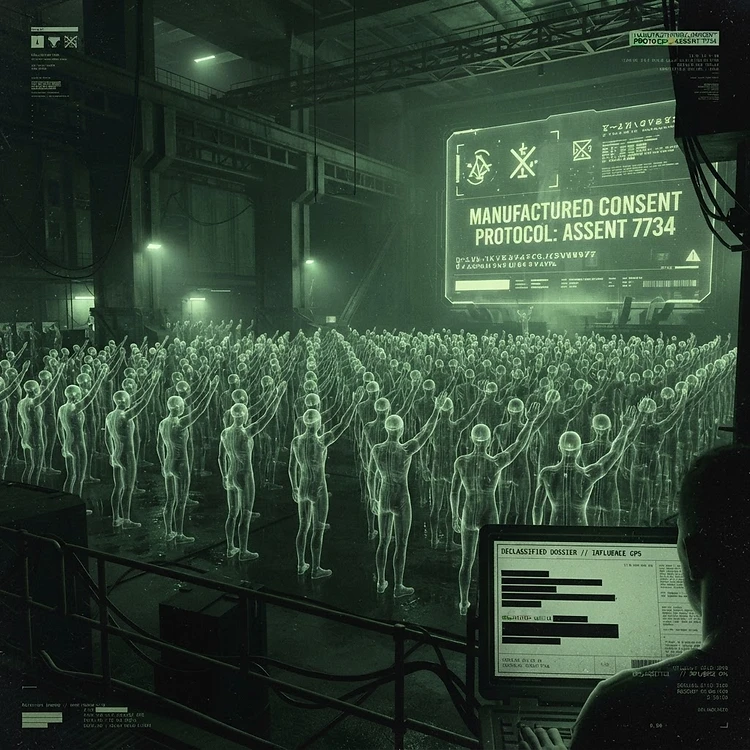
Democracy and markets depend on the signal of what the public believes. This report examines synthetic consensus — the manufacture of the appearance of public agreement through coordinated inauthentic behavior, synthetic individual expression, aggregation manipulation, and expert fabrication — why it works against decision-makers who rely on the signal, the targets it selects, and the defensive practice of signal verification, authentication, and awareness.
The Manufacture of Agreement
Democracy and markets both depend on a signal: the signal of what the public believes. The poll, the review, the rating, the trend, the consensus — each is a signal that tells the decision-maker what the public wants, and the signal is the signal the decision-maker acts on. The signal is, in its ideal form, an aggregation of genuine individual beliefs, and the aggregation is the aggregation that gives the signal its legitimacy. The operator who can fabricate the signal is an operator who can make the decision-maker act on a belief the public does not hold, and the fabrication is the fabrication that most subverts the decision-making process without the decision-maker knowing it has been subverted.
Synthetic consensus is, in 2027, the manufacture of the appearance of public agreement, and the manufacture is the manufacture that most exploits the decision-maker's reliance on the signal. The operator who generates thousands of comments, reviews, posts, and messages that appear to come from thousands of independent individuals is an operator who creates the impression of a consensus that does not exist, and the impression is the impression the decision-maker treats as real. The synthetic consensus is, in this sense, the operation that most directly attacks the signal, and the attack is the attack the decision-maker's own reliance makes effective.
The Techniques of Fabrication
The synthetic consensus is fabricated through several techniques, and the techniques are the techniques the operator most depends on.
Coordinated inauthentic behavior. The first technique is coordinated inauthentic behavior — the deployment of networks of accounts that act in concert to amplify a narrative, and the amplification is the amplification that creates the appearance of organic momentum. The accounts are, in 2027, increasingly difficult to distinguish from genuine accounts, and the difficulty is the difficulty the platform's detection most struggles with. The coordination is, in this sense, the technique that most creates the impression of a grassroots movement, and the impression is the impression the decision-maker most responds to.
Synthetic individual expression. The second technique is synthetic individual expression — the generation of comments, reviews, and posts that read as the genuine expression of a genuine individual, and the generation is the generation that the language models of 2027 have made indistinguishable from the human. The synthetic expression is, in this sense, the technique that most fills the information environment with the appearance of individual belief, and the filling is the filling the decision-maker's sampling most encounters.
Aggregation manipulation. The third technique is aggregation manipulation — the direct manipulation of the metrics that the decision-maker reads. The rating, the review count, the follower count, the poll result — each is a metric the operator can inflate, and the inflation is the inflation that most directly shifts the signal. The aggregation manipulation is, in this sense, the technique that most directly attacks the number, and the number is the number the decision-maker most trusts.
Expert fabrication. The fourth technique is expert fabrication — the creation of the appearance of expert consensus through synthetic expert voices, fabricated citations, and coordinated statements from seemingly independent authorities. The expert consensus is, in 2027, the signal the decision-maker most defers to, and the fabrication is the fabrication that most borrows the authority the decision-maker most trusts.
Why It Works
The synthetic consensus works because the decision-maker's process depends on the signal, and the signal is the signal the operator can fabricate. The decision-maker who reads the consensus is a decision-maker who treats the consensus as evidence of the public's belief, and the treatment is the treatment the operator's fabrication exploits. The decision-maker who does not have the resources to verify the consensus independently is a decision-maker who must rely on the signal as presented, and the reliance is the reliance the operator most depends on.
The synthetic consensus works, second, because the genuine consensus is difficult to distinguish from the fabricated, and the difficulty is the difficulty the platform's tools and the decision-maker's own capacity most struggle with. The comment that reads as genuine, the review that reads as authentic, the post that reads as individual — each is a piece of the consensus that the decision-maker cannot, in the time available, verify, and the inability is the inability the operator most exploits.
The synthetic consensus works, third, because the consensus, once established, reinforces itself. The decision-maker who believes the consensus is real is a decision-maker who acts on it, and the act is the act that lends the consensus the appearance of legitimacy. The press that reports the consensus is the press that amplifies it, and the amplification is the amplification that makes the consensus more difficult to challenge. The self-reinforcement is, in this sense, the property that most makes the synthetic consensus a durable weapon, and the durability is the durability the operator most values.
The Targets of the Operation
The synthetic consensus is targeted at the decision-makers who act on the signal, and the decision-makers are the decision-makers the operator most seeks to influence. The regulator who reads the public comment is a regulator the operator can shift by flooding the comment with synthetic agreement. The executive who reads the customer review is an executive the operator can shift by flooding the review with synthetic praise or criticism. The journalist who reads the trend is a journalist the operator can shift by flooding the trend with synthetic momentum. The voter who reads the poll is a voter the operator can shift by flooding the poll with synthetic preference. Each is a decision-maker who acts on the signal, and the signal is the signal the operator can fabricate.
The Defensive Practice
The defense against the synthetic consensus is, in 2027, a practice of several functions, and the functions are the functions the defense must develop.
Signal verification. The first function is signal verification — the verification of the consensus before the decision-maker acts on it. The decision-maker who has the resources to verify the consensus independently — to sample the accounts, to check the patterns, to test the authenticity — is a decision-maker who most resists the fabrication. The signal verification is, in 2027, the practice the platform, the institution, and the decision-maker must invest in, and the investment is the investment that most increases the fabrication's cost.
Authentication of expression. The second function is the authentication of expression — the cryptographic and behavioral authentication of the individual who expresses the belief. The comment that is cryptographically signed by a verified individual is a comment the operator cannot fabricate at scale, and the signature is the signature that most distinguishes the genuine from the synthetic. The authentication is, in this sense, the practice that most attacks the synthetic individual expression, and the attack is the attack the platform most needs to build.
Awareness of the technique. The third function is the awareness of the technique — the awareness, on the part of the decision-maker and the public, that the consensus can be fabricated, and the awareness is the awareness that most introduces the skepticism the fabrication most fails against. The decision-maker who knows the consensus can be fabricated is a decision-maker who treats the consensus with the skepticism the fabrication requires, and the skepticism is the skepticism the educational practice must teach.
Conclusion
Synthetic consensus is the manufacture of the appearance of public agreement, and the manufacture is the manufacture that most exploits the decision-maker's reliance on the signal. The operation is, in 2027, effective because the signal is the signal the operator can fabricate, the genuine is the genuine the decision-maker cannot distinguish, and the consensus, once established, reinforces itself. The defense is the practice of signal verification, authentication of expression, and awareness of the technique, and the practice is the practice the platform, the institution, and the decision-maker must develop together. The question is whether the signal can, in time, be made verifiable — or whether the synthetic consensus will, in 2027, be the operation that most subverts the decision-making process without the decision-maker knowing it has been subverted.
This dossier is part of the CyberArmory 2027 educational catalog. No live weapons are deployed, no named individuals are targeted, and no operational guidance for the conduct of attacks is provided.
This report was compiled by the CyberArmory 2027 Research Collective as part of an educational dossier on speculative future cyber warfare technologies. No live weapons are deployed. Every scenario is a controlled educational simulation designed to build pattern recognition and improve incident response readiness.