The Rise of AI-Enabled Precision Cognitive Warfare

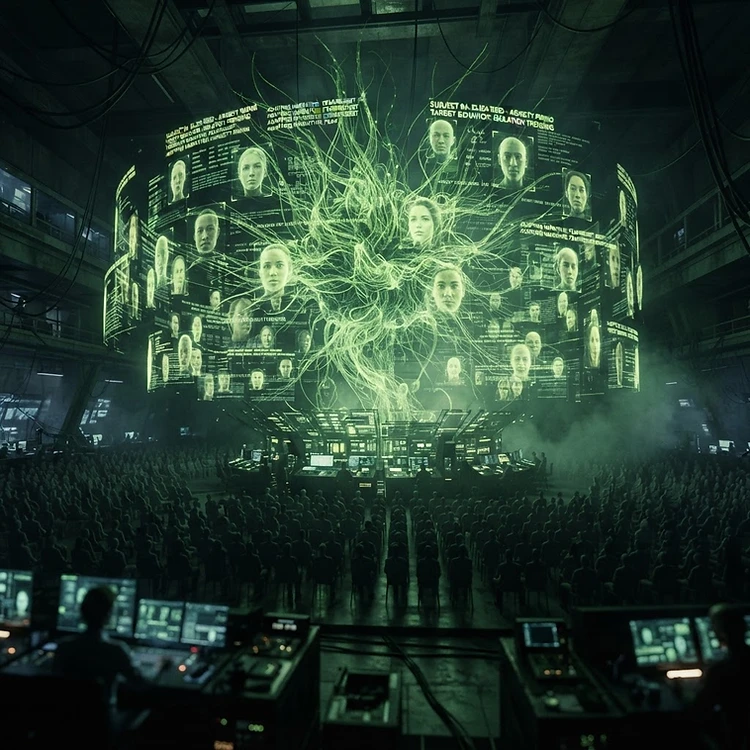
Artificial intelligence is transforming influence operations from mass messaging into highly adaptive systems that analyze audiences, tailor narratives, and react to human behavior in real time. This report examines the architecture of precision cognitive warfare, what changes in speed, scale, adaptivity, and accessibility, and why the defense must itself become a closed-loop adaptive system to counter a weapon that is a conversation rather than a broadcast.
From Broadcast to Conversation
The influence operation, for most of its history, was a broadcast. A message was crafted, a population was segmented into coarse groups, and the message was pushed at each group through the channels it could be reached through. The operation's art was the art of the message — the slogan, the image, the frame — and its scale was the scale of the broadcast infrastructure: the transmitter, the printing press, the social network's recommendation engine. The operation reached many people, but it reached them with the same message, or with a small number of messages, and it reached them in the same way. The operation was, in its structure, a megaphone.
The influence operation of 2027 is not a broadcast. It is a conversation — or, more precisely, millions of conversations, each conducted with a single person, each adapted to that person, and each continuing over time. The operation does not push a message; it reads its audience, constructs a model of each member, and generates a message that is, for that member, at that moment, optimal. The message is not crafted by a human propagandist; it is generated by a system that has observed the audience member's behavior, inferred their psychological state, and predicted which of the available narratives will most effectively move them. The operation's art is not the art of the message but the art of the model — the fidelity of the audience representation, the accuracy of the behavioral prediction, the speed of the adaptation. The operation's scale is not the scale of the broadcast infrastructure but the scale of the compute: a system that can hold a conversation with every member of a population simultaneously, and can maintain each conversation for as long as is useful.
This is precision cognitive warfare, and it is the form that influence operations take when artificial intelligence becomes their engine. The transformation is not incremental. It is a change in kind, not in degree. The broadcast operation was limited by the cost of message production and the coarseness of segmentation; the precision operation is limited by neither, because the message is produced automatically and the segment is, in the limit, the individual. The broadcast operation was a weapon of mass messaging; the precision operation is a weapon of mass personalization, and the difference is the difference between a shotgun and a sniper rifle — not in the lethality, but in the selectivity.
The Architecture of a Precision Campaign
A precision cognitive campaign is built from four components, each transformed by AI, and the integration of which is what makes the campaign qualitatively different from its predecessors.
Audience analysis. The first component is the analysis of the audience — the construction, from available data, of a model of each individual the campaign may engage. The data is, in 2027, abundant: social media activity, browsing history, purchasing behavior, location traces, communication patterns, and the vast corpus of public and semi-public information that every connected person generates. The AI's role is to turn this data into a model — not a demographic profile, but a psychological one. The model represents the individual's values, anxieties, identifications, susceptibilities to specific narratives, likely reactions to specific framings, and the network of beliefs that determines which messages will resonate and which will be rejected. A human analyst might build a detailed persona for a handful of high-value targets; an AI system builds a detailed persona for every member of a population of millions, and updates it in real time as new data arrives.
Narrative generation. The second component is the generation of the narrative — the message, the frame, the story — that the campaign will deliver to each individual. The narrative is not selected from a pre-built library; it is generated, for each individual, by a language model instructed to produce the message most likely to move that individual's model in the desired direction. The generation is an optimization problem: given the audience model, the campaign objective, and the set of available narrative elements, produce the message that maximizes the probability of the desired behavior. The generation can produce, for the same objective, radically different messages for different individuals — a message framed around economic anxiety for one, around identity threat for another, around institutional distrust for a third — and each message is, for its intended recipient, the most effective available.
Channel selection and delivery. The third component is the selection of the channel through which the narrative will be delivered, and the delivery itself. The channel is not a fixed property of the operation; it is a choice, made per individual, based on the model's prediction of which channel the individual is most receptive to at the most receptive time. The same individual might be reached through a social media feed in the morning, a direct message in the afternoon, and a comment in a community forum in the evening, with each touch delivering a different facet of the narrative, and with the sequence of touches constituting, in aggregate, a sustained conversation.
Behavioral feedback and adaptation. The fourth component is the one that most distinguishes the precision campaign from the broadcast campaign: the closed loop of behavioral feedback and adaptation. The campaign does not merely deliver messages; it observes the audience's responses — engagement, sentiment, behavior, downstream actions — and updates its models and narratives in response. The feedback loop is tight: the system can observe, within minutes, whether a message has produced the predicted reaction, and adjust the next message accordingly. The adaptation is a continuous, automatic process, and the campaign that results is not a fixed plan but a living system that evolves with its audience.
What Precision Changes
The shift from broadcast to precision changes four properties of the influence operation, and each change has strategic consequences.
Speed. The broadcast campaign's cycle — from the observation of an event to the crafting of a message to the delivery to the audience — is bounded by the human work in the middle. The precision campaign's cycle is bounded by the speed of the AI, which is, for the generation and delivery steps, effectively real time. The campaign can react to an event within seconds and deliver a tailored response to the affected audience within minutes. The speed is a strategic property, because the first message an audience receives about an event frames the event for that audience, and the framing is difficult to displace once established. The campaign that can frame the event first wins the framing.
Scale. The broadcast campaign reaches many people with one message; the precision campaign reaches many people with many messages, and the number of messages is, in the limit, the number of individuals. The campaign can conduct, simultaneously, millions of distinct conversations, each tailored to its participant, each sustained over time. The scale changes who can be reached: the broadcast campaign could not afford to reach a small, specialized audience with a tailored message, because the cost of producing the message was not justified by the size of the audience. The precision campaign can reach every audience, however small, with a tailored message, because the cost of producing the message is effectively zero. The long tail of the influence operation becomes the operation's frontier.
Adaptivity. The broadcast campaign's message is fixed, and its effectiveness is a function of how well the propagandist anticipated the audience's reaction. The precision campaign's message is adaptive, and its effectiveness is a function of how quickly the system can learn from the audience's actual reaction. The adaptivity means the campaign improves over time — the models become more accurate, the narratives more effective, the channel selections more precise — and the campaign that runs for a month is more effective than the campaign that runs for a day. The adaptivity also means the campaign can be defeated only by a defense that is itself adaptive, and the defense that is not adaptive — the fact-check that corrects a fixed message — is defeated by the campaign's next iteration, which has already moved past the corrected message.
Accessibility. The change with the broadest strategic consequences is the change in who can field a serious cognitive warfare capability. A broadcast campaign at scale required infrastructure — a television network, a printing operation, a large social media presence — and the infrastructure was expensive and concentrated. A precision campaign at scale requires compute and models, and the compute and models are, in 2027, commodities. A state can field a precision campaign; a large corporation can; a political party can; and, increasingly, a small group, a private mercenary firm, or a wealthy individual can. The capability that was the province of states and large organizations is now a commodity, and the proliferation is a function of the zero marginal cost of reproduction. The model that runs the campaign can be copied; the prompt that configures it can be shared; and the campaign that one actor fields can be re-run, with modifications, by any other actor who obtains the model and the prompt.
The Precision of the Targeting
The precision of the precision campaign is not a matter of reaching the right person. It is a matter of reaching the right person with the right message at the right time, and the integration of these three is what makes the campaign effective.
The right person is not a demographic category but a psychological one. The campaign does not target "men aged 25-34 in a specific region"; it targets individuals whose models indicate susceptibility to a specific narrative, regardless of their demographics. The targeting is psychological rather than demographic, and it is more effective because it is based on the variable that actually predicts the response — the psychological state — rather than a proxy that correlates with it. The demographic target was always a proxy, used because the true variable was unobservable; the AI's audience model makes the true variable observable, and the proxy is no longer necessary.
The right message is the message that the individual's model predicts will most effectively move them. The message is not the message the propagandist believes is most persuasive; it is the message the system has learned, from the observation of many similar individuals, is most persuasive for individuals with this model. The message may be, to an outside observer, inconsistent with the campaign's other messages — the campaign may tell one individual that a policy will help them and another that it will hurt them, because each message is optimized for its recipient, not for consistency with the others. The inconsistency is not a bug; it is a feature, because the campaign's objective is not to advance a consistent narrative but to produce a desired behavior in each individual.
The right time is the time at which the individual's model predicts they are most receptive. The receptivity is a function of the individual's state — mood, attention, recent experiences — and the state is partially observable from the behavioral data the system collects. The system can predict, for each individual, the windows in which a message will be most effective, and deliver the message in those windows. The timing is not a matter of the campaign's schedule but of the individual's state.
The Closed Loop and Its Consequences
The closed loop of behavioral feedback and adaptation is the component that most changes the campaign's strategic character, and its consequences extend beyond effectiveness to the nature of the conflict it constitutes.
The broadcast campaign was, in its relationship to the audience, a one-way transmission. The propagandist sent the message; the audience received it; the propagandist observed the aggregate effect, eventually, through polls or elections or market data. The loop was open and slow. The precision campaign is a two-way interaction. The system sends the message; the audience responds; the system observes the response and adjusts. The loop is closed and fast, and the adaptation is continuous, within the campaign.
The closed loop changes the campaign from a product to a process. The broadcast campaign was a product — a message, crafted and delivered. The precision campaign is a process — a continuous interaction that evolves with its audience. The process is harder to detect, because no single message is the campaign; the campaign is the sequence, and the sequence is visible only to an observer who watches the interaction over time. The process is also harder to counter, because the counter that rebuts one message is countered by the next message, which has adapted to the rebuttal. The defense that would counter the campaign must itself be a process — a continuous, adaptive observer that tracks the campaign's evolution and responds to each iteration.
The closed loop also changes the campaign's relationship to truth. The broadcast campaign's message was, at least in principle, a claim that could be evaluated as true or false, and the defense of fact-checking was a response to the claim. The precision campaign's message is, in many cases, not a claim but a frame — a way of seeing that, once adopted, makes the desired conclusion seem natural — and the frame is not, in the same sense, true or false. The frame is effective or ineffective, and the system that generates the frame is optimizing for effectiveness, not for truth. The defense of fact-checking, which is a defense against false claims, is not a defense against effective frames, and the precision campaign's reliance on framing rather than claiming is, in part, a response to the defense — a shift to a form the defense cannot address.
The Defensive Problem
The defense against precision cognitive warfare is, in 2027, an unsolved problem, and the reasons it is unsolved are structural.
The first reason is the asymmetry of the loop. The attacker's loop is closed and fast; the defender's loop is, in most cases, open and slow. The attacker observes the audience's response in real time and adapts; the defender observes the campaign's effect, if at all, through lagging indicators — sentiment surveys, behavioral data, electoral outcomes — and adapts, at best, on a cycle of days or weeks. The defender that is slower than the attacker is always responding to the campaign's previous iteration, while the attacker is already on the next. The asymmetry is structural, and it cannot be closed by the defender working harder. It can be closed only by the defender building a loop that is as fast as the attacker's — a cognitive defense that is itself a precision system.
The second reason is the asymmetry of the model. The attacker's model of the audience is built from the audience's behavioral data, which the attacker collects through the same channels it uses for delivery. The defender's model of the audience is, in most cases, poorer — the defender does not have the delivery channel, and so does not have the same access to the behavioral data. The defender that does not know the audience as well as the attacker cannot predict the audience's response as accurately, and cannot craft a counter-message that is as effective.
The third reason is the problem of attribution. The precision campaign is, by design, difficult to attribute to its source. The campaign is conducted through the same channels as legitimate communication, and the messages are, by design, indistinguishable from organic content. The attribution of a cognitive campaign to its sponsor is, in 2027, a problem that is, in most cases, beyond the defender's capability. The defender that cannot attribute the campaign cannot respond to its sponsor, and the response that is limited to the campaign's content is a response that the campaign's adaptivity can defeat.
The fourth reason is the problem of legitimacy. The defense against cognitive warfare is, in many cases, itself a cognitive operation — a counter-campaign, a counter-narrative, a counter-frame — and the defense that conducts a cognitive operation against its own population, or against a foreign population, is a defense that is using the same weapon it is defending against. The legitimacy of the defense is contingent on the transparency of its conduct, and the transparency is, in a closed-loop adaptive system, difficult to provide without revealing the system's methods and degrading its effectiveness. The defender is caught between the effectiveness of the closed loop and the legitimacy of the open process.
Conclusion
The rise of AI-enabled precision cognitive warfare is the transformation of the influence operation from a broadcast into a conversation — from a mass message pushed at a coarse audience into a million tailored conversations, each adapted to its participant, each sustained over time, each improving with every interaction. The transformation changes the speed, the scale, the adaptivity, and the accessibility of the influence operation, and each change has strategic consequences that the defensive community is still working to understand.
The precision campaign is not a better broadcast; it is a different kind of weapon. It is a weapon whose target is the individual's model of the world, whose payload is a frame rather than a claim, whose delivery is a conversation rather than a message, and whose effectiveness is a function of a closed loop that the broadcast campaign did not have. The weapon is, in its architecture, more like a recommendation engine than a megaphone, and the defense that would counter it must be, in its architecture, more like a recommendation engine than a fact-check.
The defensive problem is structural: the attacker's loop is faster, the attacker's model is richer, the attribution is harder, and the defense's legitimacy is constrained by the same transparency that would degrade its effectiveness. The defense that will emerge is not yet clear, but the defense that will not emerge is the defense that treats the precision campaign as a faster broadcast — the defense of fact-checking, of counter-messaging, of the fixed rebuttal. These defenses are the defenses of the previous era, and the precision campaign has, by its design, moved past them.
The question for 2027 is whether the societies that are the targets of precision cognitive warfare can build the adaptive, model-driven, closed-loop defenses that the weapon requires — or whether the asymmetry of the loop, the model, and the attribution will produce a world in which the attacker's conversation is continuous and the defender's response is always one iteration behind. The campaign is running. The audience is engaged. The loop is closed. And the question is who, in the end, is having the conversation.
This dossier is part of the CyberArmory 2027 educational catalog. No live weapons are deployed. Every scenario is a controlled educational simulation designed to build pattern recognition and improve incident response readiness.
This report was compiled by the CyberArmory 2027 Research Collective as part of an educational dossier on speculative future cyber warfare technologies. No live weapons are deployed. Every scenario is a controlled educational simulation designed to build pattern recognition and improve incident response readiness.