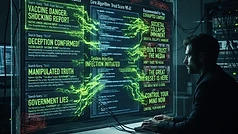
Synthetic Reality as a Strategic Weapon: The Collapse of Trust and the Cost of Proof
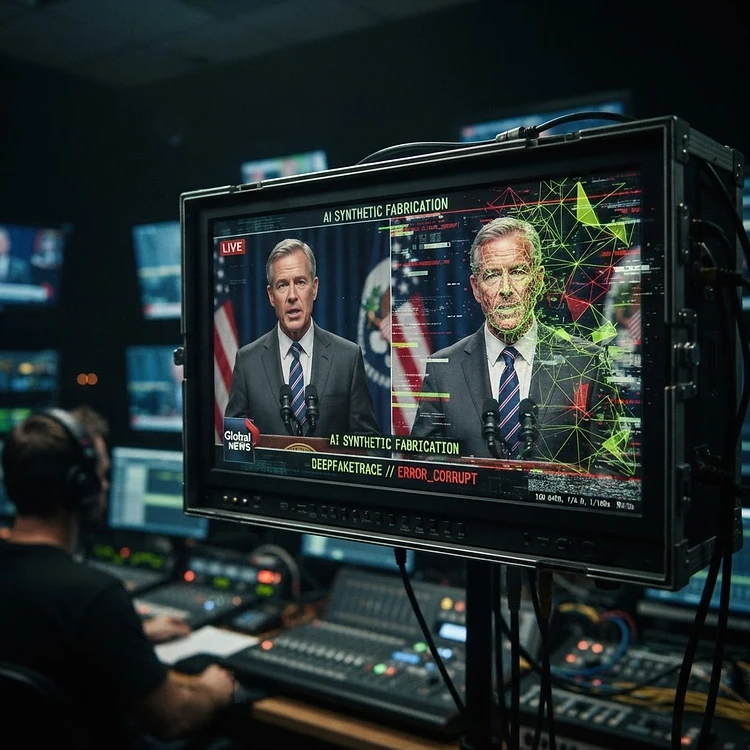
AI-generated voice, video, and documents are now wielded not as scams but as instruments of coercion, market shock, and political crisis. This report examines the deeper strategic threat — the collapse of institutional trust and the rising, asymmetric cost of proving what is real — and why provenance infrastructure, not detection, is the only structural defense.
The Weapon That Does Not Look Like One
For the better part of a decade, the conversation around synthetic media — deepfakes, AI-generated voice and video, fabricated documents — has been framed almost entirely through the lens of fraud. A cloned voice tricks a CFO into wiring money. A fake video embarrasses a public figure. A forged document supports a phishing lure. These are real harms, and they are growing more common. But they are the low end of the threat. They treat synthetic media as a tool for deception at the individual scale.
This framing misses the more consequential development. In 2027, synthetic reality is being wielded not as a scam but as a strategic weapon — an instrument of coercion, market shock, and political crisis deployed at a scale that targets institutions, markets, and nations rather than individuals. The distinguishing feature of this use is not the technology, which is the same technology used in fraud. It is the objective. The operator is not trying to steal money from a person. The operator is trying to break the relationship between a society and its sources of truth.
This is a different category of threat, and it demands a different category of analysis. The question is no longer "how do we detect a fake?" The question is "what happens to a society when the cost of believing something is real exceeds the cost of faking it?"
Beyond the Single Deepfake
The individual deepfake is a precision instrument. It targets a specific person, in a specific context, for a specific gain. It succeeds or fails on the credibility of that one artifact. This is the model that has dominated discussion, and it is the model against which most defensive effort has been directed — detection tools that examine a single file for artifacts of generation, provenance watermarks embedded in legitimate media, awareness campaigns teaching people to look for inconsistencies.
Strategic synthetic reality operates on a different logic. It is not a single artifact. It is a campaign. It is the coordinated release of multiple synthetic artifacts — voice clips, video segments, documents, social media posts, leaked communications — across multiple channels over a compressed timeframe, designed to create an impression of independent corroboration. Each individual artifact may be detectable as synthetic by a trained analyst with the right tools. But the cumulative effect is a narrative that appears to be confirmed by multiple sources, because the sources were all manufactured by the same operator.
This is the shift from deception to reality construction. The operator is not trying to make you believe one false thing. The operator is constructing an environment in which the false thing appears to be the only thing the evidence supports. The target is not a person's credulity. It is the entire information environment's ability to distinguish signal from noise.
Coercion: The Threat That Does Not Need to Be Believed
The most counterintuitive use of synthetic reality as a strategic weapon is coercion, because coercion does not require the target to believe the synthetic artifact is real. It requires only that the target cannot prove it is not.
Consider the operator who possesses authentic compromising material about a public official — or who does not, and fabricates it. The operator approaches the official and threatens to release the material. The official knows whether the authentic material exists. But the operator's leverage does not depend on the official's knowledge. It depends on the public's inability to distinguish authentic from synthetic. The official can deny the material. But in an environment where denial is indistinguishable from plausible deniability, the denial carries no weight. The official is coerced not by the truth of the material but by the impossibility of proving its falsehood to a public that has lost the ability to verify.
This is the structural innovation. In the past, coercion required authentic material, because authentic material could be proven real and therefore denied only at great cost. Synthetic material cannot be proven real, but in 2027 it also cannot be proven fake — not quickly, not conclusively, not in the timeframe in which the public forms its judgment. The coercion operates in the verification gap: the interval between the release of the material and the establishment of its provenance. That interval is now long enough, and the public's attention is short enough, that the damage is done before the verification completes.
The cost of the coercion to the operator is near zero. The cost of the defense to the target is enormous — not because the defense is difficult, but because the defense is the burden of proof, and the burden of proof in a low-trust environment is crushing. Every public figure, every executive, every institution is now, in effect, presumed capable of being framed, and must therefore prove the negative whenever material surfaces. This is not a sustainable equilibrium.
Market Shock: The Speed of Belief
Financial markets are information-processing systems. They aggregate the beliefs of participants into prices, and they do so quickly — often within minutes of new information becoming available. This speed is a feature in normal conditions. It becomes a vulnerability when the information is synthetic.
A synthetic press release announcing an unexpected acquisition, a fabricated earnings call audio in which a CEO appears to guide estimates down, a forged regulatory filing suggesting an investigation — each of these, released through the right channels at the right time, can move a stock price before any verification is possible. The market does not wait for confirmation. The market prices the information as if it were true, because in the timeframe in which the market operates, there is no distinction between "true" and "not yet proven false."
The operator's objective is not to sustain the deception. It is to exploit the window between release and refutation. A stock price that moves five percent on synthetic news and then recovers when the news is debunked has still moved five percent. An operator positioned ahead of the release captures the move. The refutation does not unwind the profit. The market's speed — the very feature that makes it efficient — is the vulnerability.
This is not a theoretical concern. The infrastructure for this attack exists today: generative models capable of producing convincing corporate communications, distribution channels that can reach market participants within minutes, and financial instruments that allow rapid positioning. The defense — slower verification, trading halts, provenance checks — is structurally slower than the offense. The asymmetry is the same one that defines all synthetic reality threats: the cost of faking is lower than the cost of proving, and the speed of faking is faster than the speed of proving.
The Contagion Effect
Market shock via synthetic media has a contagion dimension that individual fraud does not. A single fake press release targeting one company is a contained event. But synthetic media released in a coordinated campaign across multiple companies in a sector can trigger a sector-wide repricing, because the market's initial response to ambiguity is to de-risk. If three companies in an industry appear to be under investigation — even if two of the appearances are synthetic — the market does not wait to determine which two. It reprices the sector. The operator has manufactured a systemic event from fabricated inputs.
Political Crisis: The Asymmetry of Refutation
The use of synthetic reality to generate political crisis is the most studied and least understood of the strategic applications, because the dynamic is not what most analysis assumes.
The common assumption is that synthetic media works by being believed — that a fake video of a politician saying something damaging succeeds if people believe the politician said it. This framing leads to a defensive strategy focused on debunking: rapid fact-checking, official denials, labeling of synthetic content. The assumption is that if the belief is corrected, the harm is undone.
The assumption is wrong, and the reason it is wrong is the core of the strategic threat. Synthetic media in the political context works not by being believed but by being plausible. A fake video does not need to convince the majority that it is real. It needs only to provide those already inclined to believe the worst with a confirming artifact, and to impose on the target the burden of disproving it. The target's disproval, no matter how thorough, will not reach the audience that wanted to believe, and will arrive too late to matter to the audience that was undecided. The video has done its work in the interval between release and refutation.
This is the asymmetry of refutation: the cost of creating a plausible synthetic claim is near zero, the cost of definitively refuting it is high, and the refutation arrives after the claim has already shaped the narrative. In a political environment, this asymmetry is exploitable by any actor with the ability to generate synthetic media and the willingness to use it. The volume of synthetic political content is therefore increasing not because each instance is effective but because the aggregate effect — the saturation of the information environment with plausible-but-unverified claims — degrades the public's ability to use media as a basis for judgment at all.
The Trust Collapse
The deeper harm of strategic synthetic reality is not any individual deception, market move, or political crisis. It is the cumulative erosion of the baseline trust on which all of these systems depend.
Markets work because participants trust that the information they receive is, in expectation, accurate enough to price. Political systems work because citizens trust that the information they receive about candidates and events is, in expectation, accurate enough to judge. Coercion is constrained because the public trusts that authentic material can be distinguished from fabricated. Each of these systems has always tolerated some level of false information. They function because the false information is the exception, not the baseline.
Strategic synthetic reality attacks the baseline. It does not need every artifact to be believed. It needs the public to internalize the understanding that any artifact might be synthetic, and that the cost of determining which is which is high and rising. Once that understanding is internalized, the default shifts. The default is no longer "believe unless there is reason to doubt." The default becomes "doubt unless there is proof." And the proof is increasingly unavailable, because the verification infrastructure has not kept pace with the generation infrastructure.
This is the trust collapse, and it is the strategic objective of the most sophisticated operators. An operator who can degrade a society's trust in its information environment has done more damage than an operator who can steal any single secret. The stolen secret is a discrete loss. The degraded trust is a systemic one. It reduces the bandwidth of every institution that depends on information — markets, elections, courts, journalism, governance — and it does so continuously, not at a single moment.
The Cost of Proving What Is Real
The defensive response to synthetic reality has focused on detection: building tools that can identify synthetic media. This response is necessary, but it is insufficient, and it is losing ground. The reason is structural. Detection is an analytical process applied after the artifact exists. Generation is a synthetic process that creates the artifact. The generation pipeline improves faster than the detection pipeline, because generation is a creative task that benefits from the same model advances that make the fakes better, while detection is a forensic task that must keep up with each advance. The detector is always one generation behind.
This means the cost of proving an artifact is real is rising, and the cost of faking it is falling. The implication is not that we should stop trying to detect fakes. It is that detection cannot be the primary defense. The primary defense must be provenance — the ability to establish, at the moment a piece of media is created, a verifiable record of its origin that travels with the media and can be checked by anyone.
Provenance infrastructure — cryptographic signing of media at capture, content credentials embedded in files, distributed ledgers of media origin — is the only structural response to the trust collapse. It shifts the burden from "prove this is fake" to "show me this is real," and it makes the latter a matter of checking a credential rather than conducting an investigation. The infrastructure exists in prototype. It has not been deployed at scale, and the deployment is the urgent task of the next eighteen months.
The alternative is the continuation of the current trajectory: a rising cost of proof, a falling cost of fabrication, and an information environment in which the default is doubt. That is the environment the strategic operators are trying to create, and it is the environment in which every institution that depends on trust will find it harder to function.
Conclusion
Synthetic reality as a strategic weapon is not a future threat. It is a present practice. The operators using it are not trying to steal from individuals. They are trying to reshape the conditions under which institutions operate — to make coercion cheaper, markets more volatile, political contest less grounded, and trust more expensive. They are succeeding not because their fakes are perfect but because the cost of proving what is real is rising faster than the cost of faking it.
The defensive community has treated synthetic media primarily as a detection problem. It is, more fundamentally, a trust problem. Detection is a tactic. Trust is the terrain. The terrain is being lost, and the loss is measured not in individual deceptions but in the slow, cumulative erosion of the assumption that what we see and hear can, in the absence of evidence to the contrary, be believed.
That assumption was the foundation. It is the target. And the question for 2027 is whether the infrastructure to restore it can be built faster than the infrastructure to exploit its absence.
This dossier is part of the CyberArmory 2027 educational catalog. No live weapons are deployed. Every scenario is a controlled educational simulation designed to build pattern recognition and improve incident response readiness.
This report was compiled by the CyberArmory 2027 Research Collective as part of an educational dossier on speculative future cyber warfare technologies. No live weapons are deployed. Every scenario is a controlled educational simulation designed to build pattern recognition and improve incident response readiness.