Weapons Designed to Leave No Author: The Strategic Value of Doubt
Autonomous and semi-autonomous campaigns are now built to muddy attribution through false flags, copycat styles, noise injection, and operations that look like crime, accident, or a rival state. This report examines the techniques of authorlessness, the automation that has made them a practical weapon, and why the strategic value of doubt itself — blunted retaliation, fractured alliances, paralyzed policy, degraded credibility — is the true objective of the attack.
The Weapon That Wins by Not Being Found
A weapon is, in the traditional understanding, an instrument of force. Its purpose is to produce an effect — to destroy, to disable, to compel. The identity of the wielder is, in this understanding, incidental to the weapon's function. The weapon does its work whether or not anyone knows who used it.
The weapon this report examines inverts this understanding. Its purpose is not, or not only, to produce an effect. Its purpose is to produce uncertainty about who produced the effect. The effect — the disrupted service, the stolen data, the damaged system — is the means. The doubt is the end. The weapon is designed to leave no author, and the absence of an author is the result that the attacker seeks.
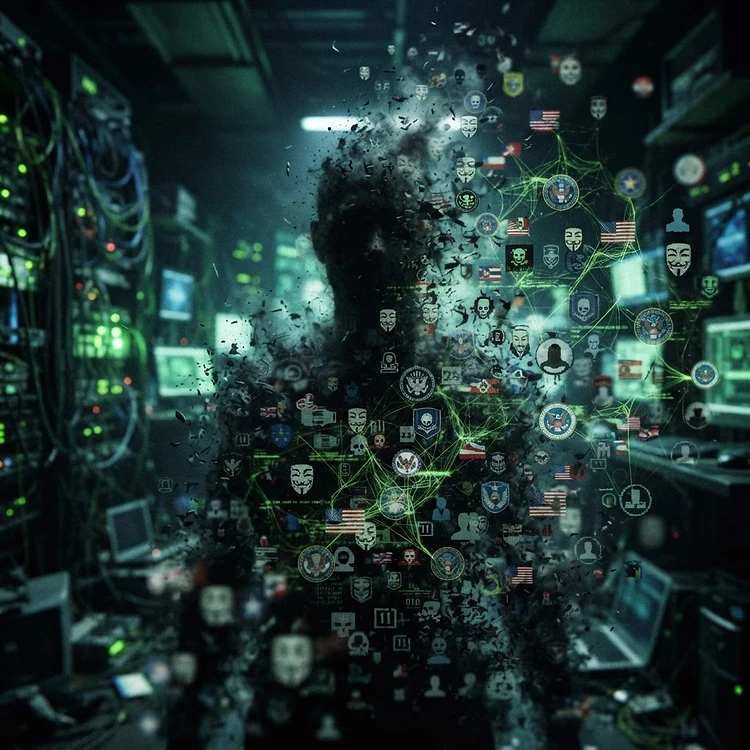
This is a weapon whose target is not the system it attacks but the attribution that follows the attack. Its objective is to ensure that the attack cannot be confidently traced to its source, and, more than that, to ensure that the attack can be plausibly attributed to several sources, none of them the true one. The weapon does not seek to escape attribution; it seeks to pollute it. It manufactures a field of candidates — a rival state, a criminal group, a hacktivist collective, an insider, an accident — and it ensures that the evidence supports each of them just enough to prevent any one from being conclusive. The result is not that no one is blamed. The result is that everyone is blamed, which is, from the attacker's perspective, the same thing.
The strategic value of this weapon is the value of doubt itself. Doubt blunts retaliation, because retaliation requires confidence. Doubt fractures alliances, because allies cannot agree on the culprit. Doubt paralyzes policy, because policymakers cannot act on a cause they cannot name. Doubt degrades the credibility of the institutions that assign attribution, because repeated inconclusive attributions make the institutions look weak. The weapon that leaves no author is, in this sense, a weapon against the attribution infrastructure of the target society — the set of institutions, norms, and capabilities that turn a cyber incident into a named, blameable, actionable event.
The Attribution Problem
To understand the weapon, it is necessary to understand the attribution problem it exploits.
Attribution in cyber conflict is the process of tracing an attack from its effect back to its cause, and from its cause to the actor responsible. It is a process that combines technical forensic work — the analysis of malware, infrastructure, and techniques — with intelligence work — the assessment of capability, intent, and opportunity across the set of candidate actors. The output of the process is, at best, a confident judgment: this actor, with this level of certainty, is responsible. At worst, the output is a set of candidates, each with some support, none conclusive.
The attribution process is not, and has never been, purely technical. Even the strongest technical indicators — a malware signature, a command-and-control IP address, a known exploit chain — require an intelligence judgment to connect them to an actor. The same malware can be shared, sold, or stolen; the same infrastructure can be rented or compromised; the same techniques can be copied. The technical evidence establishes what happened; the intelligence judgment establishes who did it, and the judgment is, necessarily, probabilistic.
The weapon that leaves no author attacks the probabilistic core of the attribution process. It does not seek to eliminate the technical evidence — that would be suspicious, and its absence would itself be an indicator. It seeks to ensure that the technical evidence points, with roughly equal weight, to several actors. The malware uses techniques associated with one group; the infrastructure overlaps with another; the timing aligns with the interests of a third; the target profile matches the operations of a fourth. Each indicator is real. Each is, in isolation, suggestive. Together, they do not converge — they diverge, and the divergence is the weapon's design.
The Techniques of Authorlessness
The construction of an authorless campaign is a discipline, and like any discipline it has a set of techniques. The techniques of 2027 are more developed, more reliable, and more automatable than those of a decade earlier, and the automation is the change that has made the authorless campaign a practical weapon rather than a rare craft.
False flags. The oldest technique, and still the most effective, is the false flag — the deliberate inclusion of indicators associated with another actor. A false flag can be as simple as leaving comments in a language associated with a rival, or as sophisticated as replicating the full operational pattern of a known group. The false flag does not need to be perfect; it needs to be good enough that the attribution process, which weighs indicators probabilistically, assigns meaningful probability to the flagged actor. A perfect false flag is not required, because the attribution process does not require perfect evidence to assign blame — it requires only that one candidate's probability rises above the threshold of action. The false flag raises a second candidate's probability to compete with the true one, and the competition is enough to prevent the threshold from being crossed.
Copycat styles. A refinement of the false flag is the copycat style — the adoption of not just the indicators but the operational signature of another actor, to a degree that the two campaigns are difficult to distinguish. The copycat style requires a deep understanding of the target actor's tradecraft, which is, in 2027, available to any operator with access to the body of published threat intelligence. The published record of how known groups operate — their tools, their sequences, their preferences — is a manual for imitation, and the imitation is more convincing than any fabricated indicator, because it reproduces the behavior, not just the artifacts. The copycat campaign does not look like an attack that is trying to look like another actor; it looks like the other actor, and the difference is the difference between a costume and a performance.
Crime, accident, rival. The most powerful authorless technique is the construction of an attack that does not look like an attack at all — that looks like a crime, an accident, or the action of a rival. A ransomware deployment that looks like a criminal monetization operation, with no geopolitical signature, obscures the state actor behind it. A system failure that looks like an accidental misconfiguration, with no malicious artifact, obscures the sabotage behind it. A data exfiltration that looks like the routine espionage of a rival state, with the rival's indicators planted in the infrastructure, obscures the true collector. The technique works because the attribution process, faced with a plausible non-attack explanation, is biased toward the explanation that does not require an attacker. The process is designed to find attackers, and when the evidence supports the absence of an attacker, the process accepts the absence and stops looking.
Noise injection. The authorless campaign does not only plant indicators pointing to other actors; it floods the attribution process with indicators pointing everywhere. The campaign uses a wide range of tools, a wide range of infrastructure, a wide range of techniques, and a wide range of targets, such that any attempt to cluster the activity into a single actor produces a low-confidence result. The noise is not random — it is designed to maximize the entropy of the attribution, to ensure that every candidate actor has some supporting evidence and no candidate actor has enough. The noise injection is the technique that most benefits from automation, because the volume of activity required to produce sufficient entropy is beyond the capacity of a manual operator. An autonomous campaign can generate the volume; a manual one cannot.
The Autonomous Authorless Campaign
The change that has elevated the authorless campaign from a rare craft to a practical weapon is autonomy. The techniques of authorlessness — false flags, copycat styles, noise injection — have existed for as long as cyber conflict has. What is new in 2027 is the ability to execute them at scale, consistently, and without the human tradecraft that previously limited their use.
An autonomous or semi-autonomous campaign can be instructed to operate in the style of a specified actor, and the instruction is sufficient to produce a campaign that reproduces that actor's signature across a range of operations. The instruction does not require the operator to possess the tradecraft; the tradecraft is encoded in the system, which has been trained on the published record of the target actor's behavior. The operator defines the target, the objective, and the actor to imitate; the system executes the campaign, and the campaign's attribution signature is the signature of the imitated actor, not the operator.
The autonomy also enables the noise injection at a scale that manual campaigns could not achieve. An autonomous campaign can run dozens of parallel operations, each with a different signature, against a range of targets, such that the aggregate activity in the target environment is a noise floor of conflicting indicators. The attribution process, attempting to isolate the campaign of interest from the noise, faces a signal-to-noise problem that is, by design, intractable. The campaign is not hidden in the noise; it is the noise, and the noise is the weapon.
The semi-autonomous campaign, in which a human operator directs the strategic choices and the system executes the tactical tradecraft, is the most practical form of the authorless weapon in 2027. The human provides the judgment that the system cannot — which actor to imitate, which target to attack, which effect to produce — and the system provides the consistency and volume that the human cannot. The combination is an authorless campaign that is both strategically coherent and tactically indistinguishable from the activity of other actors, which is the design objective of the weapon.
The Strategic Value of Doubt
The weapon that leaves no author is a weapon whose effect is produced not by the attack it conducts but by the doubt it generates. The doubt is the weapon's product, and its strategic value is realized through the consequences of doubt in the target society.
Retaliation blunted. The first consequence of doubt is the blunting of retaliation. Retaliation — whether cyber, economic, or kinetic — requires a political decision, and a political decision requires a level of confidence that can sustain the decision against the inevitable criticism. Doubt provides the material for the criticism. The decision to retaliate against actor A is challenged by the evidence that points to actor B, and the challenge is sufficient to prevent the decision, or to delay it past the point of effectiveness. The weapon that leaves no author does not need to prevent retaliation absolutely; it needs to prevent retaliation in the window in which retaliation would be effective, and the window is short.
Alliances fractured. The second consequence is the fracturing of alliances. A cyber incident attributed to a rival state is a basis for collective response among allies, but only if the allies agree on the attribution. The authorless weapon, by producing a field of candidates, ensures that the allies do not agree. One ally's intelligence service assesses actor A; another's assesses actor B; the disagreement is not a failure of intelligence but a consequence of the evidence, which supports both. The collective response that would follow a confident attribution does not follow an inconclusive one, and the alliance's coherence is degraded by the disagreement, even if no ally is at fault.
Policy paralyzed. The third consequence is the paralysis of policy. Policymakers, asked to respond to a cyber incident, require a named cause to which to respond. The authorless weapon denies them the named cause. The policy options — sanctions, indictments, diplomatic protests, offensive operations — all require a target, and the target requires an attribution. The inconclusive attribution leaves the policy options without a target, and the options expire in the waiting. The incident recedes from the news cycle; the policy window closes; the response that would have been available with a confident attribution is no longer available, because the political momentum has dissipated.
Credibility degraded. The fourth consequence is the degradation of the attribution infrastructure's credibility. The institutions that assign attribution — intelligence services, private threat intelligence firms, international bodies — derive their authority from the confidence of their judgments. Repeated inconclusive attributions, in which the institutions can say only that the attack was conducted by "an actor with characteristics of A and B," erode the confidence. The public, and the policymakers, learn that the institutions' judgments are, in these cases, not actionable, and they begin to discount the institutions' judgments in all cases. The authorless weapon, by producing a stream of inconclusive attributions, degrades the infrastructure that would attribute its own future operations — a recursive advantage that compounds with use.
The Defensive Problem
The defense against the authorless weapon is, in 2027, an unsolved problem, and the reasons it is unsolved are structural.
The attribution process is, by design, an inference from evidence to actor. The authorless weapon attacks the inference, not the evidence. The evidence is present, and is, in many cases, accurate; the problem is that the evidence supports multiple inferences, and the process has no basis, within itself, to choose among them. The choice requires intelligence — context about capability, intent, and opportunity that the technical evidence alone does not provide — and the intelligence is, in the cases where the authorless weapon is most effective, deliberately ambiguous. The defense cannot solve the problem by collecting more evidence, because the evidence is the weapon's medium; more evidence, in a field of planted indicators, produces more candidates, not more confidence.
The defense can, in principle, solve the problem by raising the cost of authorlessness — by making the construction of a convincing false flag, copycat style, or noise campaign expensive enough that fewer actors can undertake it. This is a defense through deterrence of the weapon's production, not through detection of the weapon's use. It requires the identification and disruption of the infrastructure that enables authorless campaigns — the markets in tradecraft, the published threat intelligence that serves as a manual for imitation, the autonomous systems that can execute the techniques at scale. Each of these is a target, and each is a difficult one, because they are embedded in the legitimate infrastructure of the cybersecurity field.
The defense can also, in principle, solve the problem by accepting that attribution will, in some cases, be inconclusive, and by developing response frameworks that do not require confident attribution. This is the most honest and, in 2027, the least developed approach. It requires a shift from a retaliation model, which requires a named culprit, to a resilience model, which does not. The resilience model accepts that some attacks will not be attributable, and it invests in the ability to absorb, recover from, and continue operating through attacks regardless of their source. The shift is difficult, because it requires policymakers to accept that some attacks will go unpunished, and that the alternative — punishing the wrong actor, or punishing no one — is worse.
Conclusion
The weapon designed to leave no author is a weapon against the attribution infrastructure of the target society. Its objective is not the effect of the attack but the doubt that follows the attack, and the doubt is produced by design — through false flags, copycat styles, noise injection, and the construction of attacks that look like crime, accident, or a rival's work. The doubt blunts retaliation, fractures alliances, paralyzes policy, and degrades the credibility of the institutions that assign blame.
The autonomy of 2027 has made the authorless campaign a practical weapon. The techniques that were once the craft of a few sophisticated actors are now executable by any operator with access to an autonomous system and the published record of other actors' behavior. The volume of activity required to produce sufficient attributional entropy is, for the first time, achievable, and the campaigns that achieve it are, by design, indistinguishable from the activity of the actors they imitate.
The defensive problem is structural: the attribution process is an inference, and the weapon attacks the inference by polluting the evidence. The defense cannot solve the problem by collecting more evidence, because the evidence is the weapon's medium. The defense requires either the disruption of the infrastructure that enables authorlessness, or the development of response frameworks that do not require confident attribution. The first is hard; the second is harder, because it requires a cultural shift in how societies respond to attack.
The attack is over. The evidence is in. The culprit is everyone. And the question for 2027 is whether the attribution infrastructure can be rebuilt to resist a weapon whose purpose is to make attribution impossible — or whether the doubt that the weapon produces becomes, itself, the new normal of cyber conflict, in which no attack is ever confidently attributed, and no response is ever confidently mounted, and the attacker operates in the space that the doubt creates.
This dossier is part of the CyberArmory 2027 educational catalog. No live weapons are deployed. Every scenario is a controlled educational simulation designed to build pattern recognition and improve incident response readiness.
This report was compiled by the CyberArmory 2027 Research Collective as part of an educational dossier on speculative future cyber warfare technologies. No live weapons are deployed. Every scenario is a controlled educational simulation designed to build pattern recognition and improve incident response readiness.