When the Operator Is No Longer Human: The Age of Autonomous Cyber Offense
According to CyberArmory 2027's offensive threat research, highly autonomous cyber agents now run long campaigns with minimal human steering. Hands-off-keyboard offense collapses the attacker's OODA loop to machine speed, scales simultaneous operations beyond human limits, and lowers the expertise barrier so the question becomes who has the software.
The Empty Chair
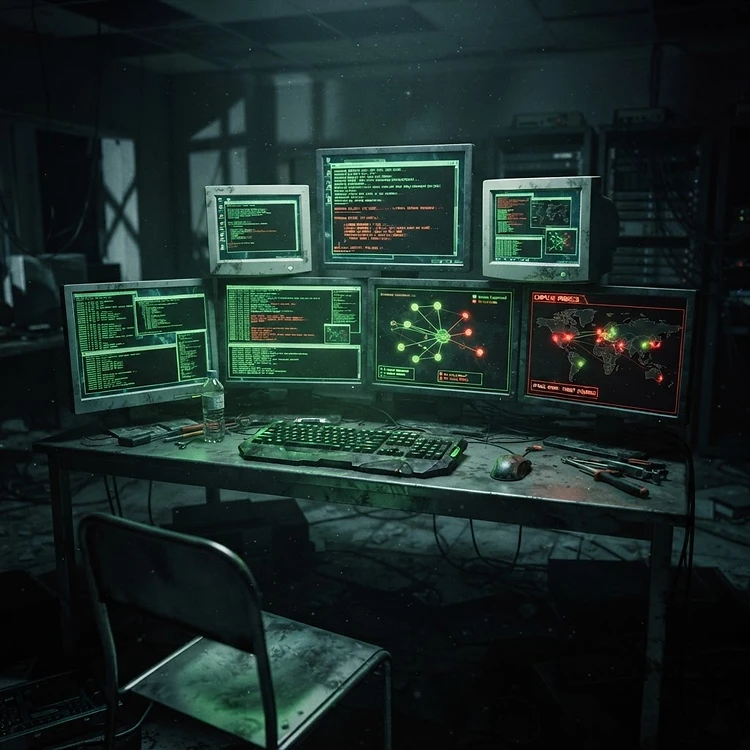
There is a scene playing out in offensive operations centers that would have been unimaginable five years ago. A campaign is running. Reconnaissance is being conducted, vulnerabilities are being identified, initial access is being achieved, lateral movement is underway, and data is being staged for exfiltration. The campaign has been running for seventy-two hours. It has adapted to three different defensive responses, switched exploitation techniques twice, and maintained persistence across a network reorganization. And the operator's chair is empty.
This is the reality of highly autonomous cyber agents in 2027 — systems capable of conducting long-duration offensive campaigns with minimal human steering. The phrase that has emerged in the operational community to describe this shift is "hands-off-keyboard" offense. It refers to a mode of operation in which the human is no longer the one typing the commands, reading the responses, and making the decisions. The human sets an objective, defines constraints, and then steps back. The agent does the rest.
This is not automation in the traditional sense. Automation executes a predetermined sequence of actions. Autonomous agents reason about their environment, select between options, adapt to failures, and pursue objectives over extended periods. The distinction matters because it changes three fundamental properties of offensive operations: speed, scale, and accessibility. Each of these changes has strategic consequences that the defensive community is only beginning to understand.
What "Hands-Off-Keyboard" Actually Means
To understand why this shift matters, it is necessary to be precise about what has changed. Traditional offensive operations, even those assisted by automation frameworks, required continuous human involvement. An operator would run a tool, examine the output, decide what to do next, and execute the next step. The operator's judgment was in the loop at every stage. A campaign of any complexity required a skilled human to be present, attentive, and making decisions for hours or days.
Autonomous cyber agents remove the human from this loop. The agent is given an objective — compromise a target network, maintain access for thirty days, exfiltrate a specific dataset — and a set of constraints defining what it may and may not do. The agent then plans and executes the campaign independently. It conducts reconnaissance, selects techniques, attempts exploitation, processes failures, adapts its approach, and continues toward the objective. A human may review periodic reports or intervene when the agent encounters a situation outside its authorization, but the human is not in the operational loop.
The key technical enablers of this capability are:
- Reasoning models capable of decomposing complex objectives into executable sub-tasks and adapting when sub-tasks fail.
- Tool-use frameworks that allow the agent to invoke external capabilities — scanners, exploit frameworks, credential theft tools, lateral movement utilities — as needed.
- Persistent memory that allows the agent to retain context across a campaign lasting days or weeks, remembering what it has tried, what worked, and what the target environment looks like.
- Environment interaction capabilities that allow the agent to observe the results of its actions and update its model of the target accordingly.
The combination of these capabilities produces a system that can pursue an objective over a long duration without requiring the continuous attention of a human operator. The keyboard is unattended. The campaign continues.
Speed: From Human Time to Machine Time
The first dimension of change is speed. Human operators are bounded by the speed of cognition and the speed of typing. A skilled operator can execute perhaps one significant action per minute — running a tool, reading the output, making a decision, executing the next step. Over an eight-hour shift, that is roughly five hundred actions. Over a day, with a team working in shifts, perhaps fifteen hundred.
An autonomous agent operates at machine speed. It can execute actions in seconds, process outputs in milliseconds, and make decisions without the latency of human cognition. A single agent can conduct thousands of actions per hour. More importantly, it can maintain this pace continuously, without fatigue, without distraction, and without the need for shift changes. A campaign that would take a human team a week can be completed by an autonomous agent in hours.
This speed differential has a compounding effect. In offensive operations, speed is not just about efficiency — it is about the window of defender visibility. Defensive tools detect attacks by observing patterns over time. An attack that completes before the detection window opens is invisible. An attack that adapts faster than the defender can update detection rules evades every rule. The speed of autonomous agents compresses the defender's reaction window to the point where traditional detection-and-response cycles cannot keep up.
The OODA Loop Collapse
Military doctrine describes the decision cycle as the OODA loop: Observe, Orient, Decide, Act. The combatant who completes the OODA loop faster gains the advantage, because they act inside the opponent's decision cycle. Traditional cyber operations were a contest of human OODA loops — attacker versus defender, both bounded by human cognition.
Autonomous agents complete the OODA loop at machine speed. The attacker's loop now runs orders of magnitude faster than the defender's, if the defender is still operating with humans in the loop. This is not a marginal advantage. It is a structural one. A defender who cannot match the attacker's loop speed will always be reacting to the previous action, not the current one. The defender is perpetually one step behind, and in offensive operations, one step behind is enough to lose.
Scale: From One Target at a Time to Many Simultaneously
The second dimension of change is scale. A human operator, no matter how skilled, can focus on one target at a time. A human team can focus on a handful. The number of simultaneous operations an organization can field is bounded by the number of operators it can deploy, and skilled operators are scarce and expensive.
Autonomous agents scale differently. A single agent can be instantiated many times. Ten, a hundred, a thousand copies of the same agent can operate simultaneously against different targets, each conducting its own independent campaign. The constraint is no longer operator headcount — it is compute budget. And compute is cheap, elastic, and continuously falling in cost.
This changes the economics of offensive operations in ways that have strategic consequences. An operation that required a team of ten operators to conduct against one target can now be conducted against a hundred targets simultaneously by the same team, with the humans serving as supervisors rather than operators. The cost per target falls by orders of magnitude. Operations that were previously impractical because of resource constraints become routine.
The Saturation Problem
Scale creates a defensive problem that is qualitatively different from anything the community has faced before. Defensive systems are designed to detect and respond to attacks. They are not designed to detect and respond to hundreds of simultaneous, adaptive, machine-speed attacks. A Security Operations Center that can handle ten concurrent incidents will be overwhelmed by a hundred. The defensive infrastructure — alerting, triage, response, forensics — does not scale the way offensive capability now scales.
This is the saturation problem. An adversary with autonomous agents does not need to defeat the defender's detection capabilities. It needs only to generate enough simultaneous activity to exceed the defender's capacity to respond. The attacks that get through are not the most sophisticated — they are the ones that arrived when the defender was busy with the others.
Accessibility: Who Can Field a Serious Capability
The third dimension of change is the most strategically significant: accessibility. For the entire history of offensive cyber operations, the barrier to fielding a serious capability was human expertise. Conducting a sophisticated campaign required operators with years of training, deep knowledge of systems and vulnerabilities, and the judgment to adapt in real time. This expertise was rare, expensive, and concentrated in a small number of organizations — nation-state intelligence services, a handful of elite contractors, and a very small number of criminal groups.
Autonomous agents change this equation by encoding expertise into software. An autonomous agent that can conduct a sophisticated campaign does not require its operator to possess the skills that the campaign demands. The operator needs to understand the objective and the constraints, not the techniques. This means that the capability to field a serious offensive operation — the kind that previously required a nation-state budget and a team of experts — is now accessible to a much broader range of actors.
This is the democratization of offensive capability, and it is the most consequential development in the 2027 threat landscape. When the expertise is in the agent rather than the operator, anyone who can obtain and deploy the agent can conduct operations that were previously beyond their reach. The barrier falls from "assemble a team of experts" to "obtain a software product."
The Lowering Threshold
The practical consequences of this lowering threshold are already visible:
- Criminal groups that previously conducted low-sophistication mass campaigns can now conduct targeted, adaptive operations against high-value targets.
- Hacktivist collectives with motivation but limited expertise can field capabilities that rival those of nation-state operators.
- Small nation-states that could not previously afford to develop offensive cyber capabilities can purchase them off the shelf.
- Individuals with sufficient resources can conduct operations that would have required an intelligence agency a decade ago.
The total number of actors capable of conducting serious offensive operations is growing rapidly. The defensive community is not growing at the same rate. The asymmetry that has always favored the attacker in cyber operations is widening, and the width of the gap is now determined by the rate of autonomous agent adoption rather than the rate of human expertise development.
The Campaign Duration Problem
A less discussed but equally significant aspect of autonomous agents is their ability to sustain campaigns over long durations. Human operators tire, rotate, move to other projects, and lose context. A human-run campaign that lasts more than a few weeks is rare, because maintaining the attention and context required is extraordinarily difficult.
Autonomous agents do not tire. They do not lose context. An agent can maintain access to a target network for months, conducting low-level reconnaissance, mapping changes to the environment, and waiting for the right moment to act — all without any human attention. The campaign duration is bounded only by the agent's ability to maintain persistence and the defender's ability to detect it.
This creates a new class of threat: the long-duration, low-signal campaign. An agent that maintains access for six months, conducting minimal activity, is nearly impossible to detect through behavioral analysis. The activity is too sparse to form a pattern. The duration is too long for a human analyst to maintain awareness. The agent is present, patient, and invisible.
Defensive Implications
The defensive implications of hands-off-keyboard offense are profound and uncomfortable. The traditional model of defense — detect, triage, respond, with humans in the loop — is structurally outmatched by an adversary operating at machine speed, machine scale, and with expertise encoded in software.
Several principles are emerging for defense in the autonomous era:
Autonomous defense is necessary, not optional. The only effective response to an autonomous attacker is an autonomous defender. Organizations must deploy detection and response systems that operate at machine speed, without waiting for human triage. This is not a convenience — it is a survival requirement.
Deception as a primary defense. When the attacker is an autonomous agent reasoning about its environment, defensive deception — honeytokens, fake assets, misleading responses — becomes uniquely effective. An agent that cannot distinguish real assets from deceptive ones will waste its campaign on false targets, and its reasoning about the environment will be poisoned by false data. Deception attacks the agent's decision-making process, not its tools.
Behavioral baselines at machine granularity. Detection must move beyond signature-based and simple anomaly-based approaches to behavioral baselines that capture the normal state of every asset at a level of detail that reveals the subtle signals of a patient, low-activity agent. This requires continuous, automated monitoring that no human team can sustain.
Assume breach, design for containment. Given the speed and scale of autonomous threats, prevention cannot be the primary strategy. Organizations must assume that initial access will be achieved and design their environments to contain the blast radius — segmentation, least privilege, and micro-perimeters that limit what a compromised agent can reach.
The Operator's New Role
The shift to autonomous offense does not eliminate the human operator. It changes the operator's role. The operator of 2027 is not a technician executing actions but a strategist defining objectives, a policymaker setting constraints, and a supervisor reviewing outcomes. The skill set shifts from technical execution to strategic judgment.
This is not a diminishment of the human role. It is an elevation. The decisions that matter most in the autonomous era are not "which exploit to run next" but "what objectives are authorized, what constraints are imposed, and what happens when the agent encounters a situation it was not designed for." These are questions of policy, ethics, and risk management, not technical skill.
The organizations that navigate this transition successfully will be those that recognize this shift and develop the human capabilities to match. The operator who can define a precise objective, set effective constraints, and supervise an autonomous campaign is more valuable than the operator who can execute a campaign manually. The former can field a hundred simultaneous operations. The latter can field one.
Conclusion
The empty chair in the operations center is not a vision of the future. It is the present reality of offensive operations. The operator is no longer required to be at the keyboard. The campaign runs itself. And the consequences — for speed, for scale, for who can field a serious capability — are reshaping the entire landscape of cyber conflict.
The defensive community has a choice. It can continue to build defenses designed for a world in which the attacker is a human at a keyboard, and be outmatched by adversaries who have moved beyond that model. Or it can recognize that the operator is no longer human, and build defenses designed for the world that actually exists.
The keyboard is unattended. The campaigns are running. The question is whether your defenses are designed for the operator who is no longer there.
This dossier is part of the CyberArmory 2027 educational catalog. No live weapons are deployed. Every scenario is a controlled educational simulation designed to build pattern recognition and improve incident response readiness.
This report was compiled by the CyberArmory 2027 Research Collective as part of an educational dossier on speculative future cyber warfare technologies. No live weapons are deployed. Every scenario is a controlled educational simulation designed to build pattern recognition and improve incident response readiness.